




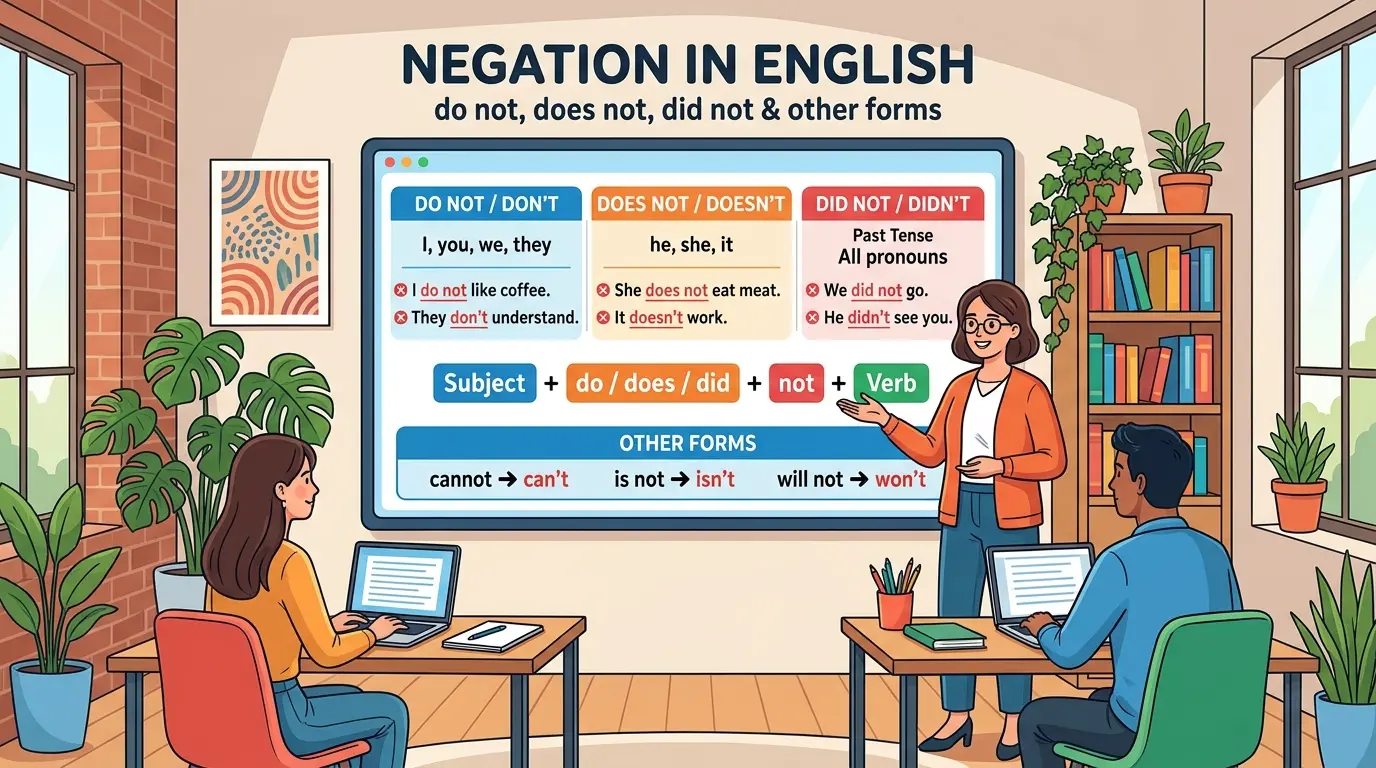
To make an English sentence negative, first look at its verb. Use do not, does not or did not with ordinary main verbs in the present simple or past simple. With be, an existing auxiliary or a modal, put not after that verb instead. English also uses no, never, nobody and nothing, but these words do different jobs.
Do not, does not and did not
The basic pattern is subject + do/does/did + not + base form. Use does with he, she and it in the present; use do with I, you, we and they. Did works with every subject in the past. The auxiliary carries the tense and person: after does not, the main verb loses its -s; after did not, it is not a past-tense form.
| Statement | Negative | Meaning |
|---|---|---|
| I work on Saturdays. | I do not work on Saturdays. | Working on Saturdays is not my routine. |
| She knows the password. | She does not know the password. | She does not have that information. |
| They left early. | They did not leave early. | They did not depart early. |
The same rule applies when do is the main verb: He does not do the shopping. The first does is the auxiliary; do names the activity. Two forms of do in one sentence are therefore correct.
Be, auxiliaries and modal verbs: where not goes
Do not add do when the sentence already has an auxiliary or modal. Put not after the first one. Main-verb be also takes not directly: The room is not available. With several verbs, keep the remaining forms unchanged: She has not been sleeping well.
| Construction | Example |
|---|---|
| be | I am not ready. / They were not at home. |
| Continuous | We are not waiting outside. |
| Perfect | He has not sent the invoice. |
| Passive | The parcel was not delivered. |
| Modal verb | You should not share this code. / We will not cancel. |
Have needs special attention. In perfect tenses, have is an auxiliary: I have not seen the message. For possession with ordinary have, use I do not have a printer. With have got, use I have not got a printer. Both possession patterns are standard; do not combine them into “I do not have got”.
Short forms: don’t, isn’t, can’t and won’t
Contractions are normal in conversation and informal writing. Full forms are useful for emphasis and are often preferred in formal writing. The apostrophe marks omitted letters; the sentence structure stays the same.
| Full form | Contraction |
|---|---|
| do not / does not / did not | don’t / doesn’t / didn’t |
| is not / are not | isn’t / aren’t |
| was not / were not | wasn’t / weren’t |
| have not / has not / had not | haven’t / hasn’t / hadn’t |
| cannot / could not | can’t / couldn’t |
| will not / would not | won’t / wouldn’t |
| should not / must not | shouldn’t / mustn’t |
Write cannot as one word for the usual negative of can. Will not becomes won’t, not “willn’t”. In ordinary standard statements, use I’m not; “I amn’t” is not the general standard form. Both she isn’t and she’s not are correct, as are they aren’t and they’re not.
Not or no?
Not negates a verb phrase or another element: She is not tired. No comes before a noun phrase and expresses zero quantity or the absence of something: There is no milk, We have no appointments today. No replaces an article: use no ticket, not “no a ticket”.
I have no cash. = I do not have any cash.
Both sentences say that the speaker has no cash.
After a negative verb, any is common with plural and uncountable nouns: We did not receive any emails. But not every negative sentence needs any: I do not like this coffee refers to specific coffee. Likewise, This is not my ticket denies ownership; it does not say that no ticket exists.
Never, nobody and nothing: avoid an extra not
In neutral standard English, never, nobody, no one, nothing and nowhere already make the clause negative. Do not add not to express the same single negation. Compare I did not see anyone with I saw no one. Both are standard; “I did not see no one” is not the neutral standard pattern for this meaning.
| Negative word | Example | Placement or form |
|---|---|---|
| never | He never drives at night. | Before an ordinary main verb. |
| never | She has never tried sushi. | After the first auxiliary; after main-verb be: He is never late. |
| nobody / no one | Nobody knows the answer. | As subject, takes a singular verb. |
| nothing | Nothing has changed. | No additional not. |
Hardly and rarely also have a negative or near-negative meaning: I hardly know him means I know him very little. Do not add not if that is the intended meaning.
Must not and do not have to mean different things
Must not expresses a prohibition; do not have to expresses absence of necessity. You must not enter this room means entry is forbidden. You do not have to attend the meeting means attendance is optional. You can also say You do not need to attend or You need not attend. Notice the two patterns: ordinary need uses do and to; modal need uses neither.
Negative commands and infinitives
For a negative command, use do not / don’t + base form, including with be: Don’t touch the screen, Don’t be late. For a negative to-infinitive, a neutral pattern is not to + verb: She asked us not to park there. Do not insert do into that infinitive.
Negative questions and clear answers
In a contracted negative question, the auxiliary and n’t come before the subject: Didn’t you receive the email? With the full form, not normally follows the subject: Did you not receive the email? Such questions often express surprise or check an expectation. Answer according to what happened: Yes, I did means you received it; No, I didn’t means you did not.
Common mistakes with English negatives
| Incorrect | Correct | Reason |
|---|---|---|
| She doesn’t likes tea. | She doesn’t like tea. | Base form after does. |
| We didn’t went out. | We didn’t go out. | Did carries the past tense. |
| He doesn’t can swim. | He cannot swim. | No do with can. |
| I don’t am tired. | I am not tired. | Put not after be. |
| There is no a lift. | There is no lift. | No replaces the article. |