
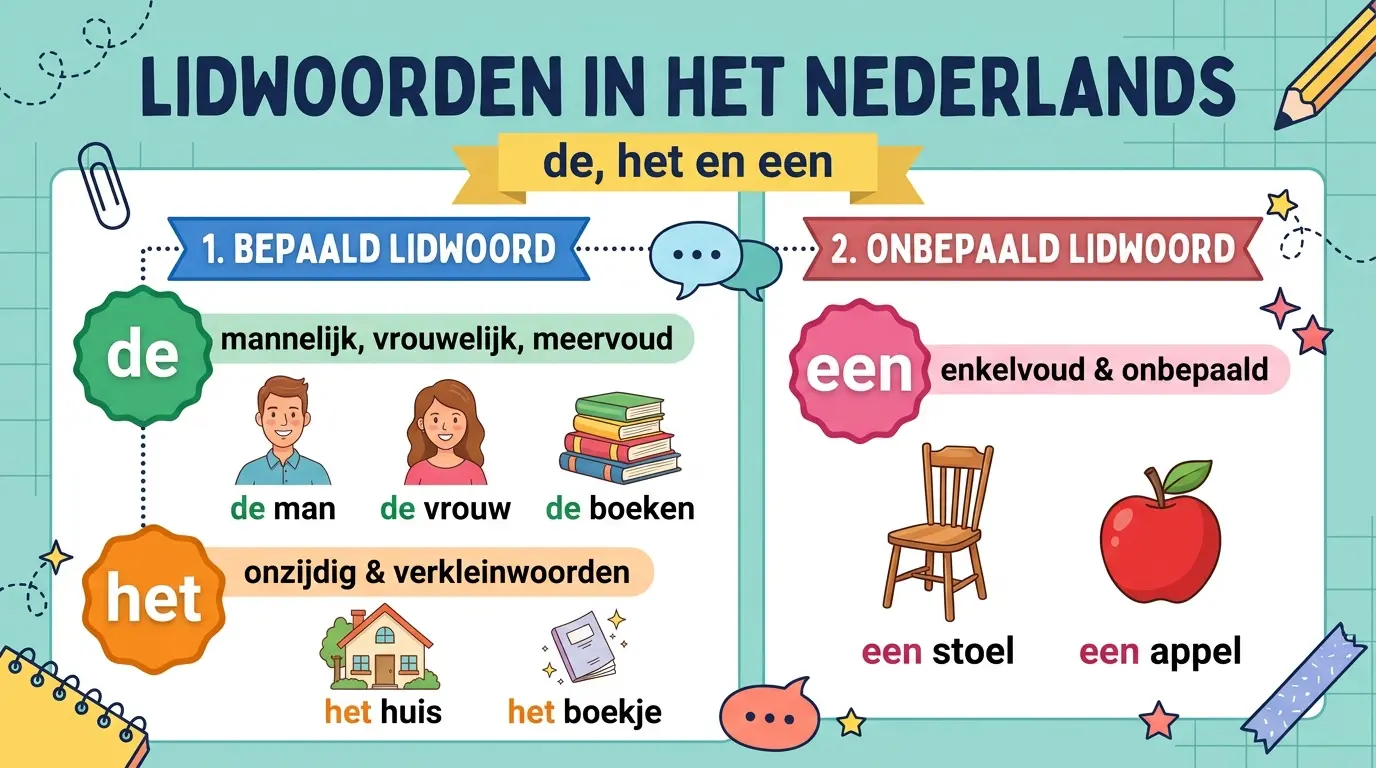
Dutch has three articles: de, het and een. De and het are definite articles: they usually show that the reader or listener can identify what you mean. Een is the indefinite article, used with a singular countable noun. Choosing correctly involves both meaning and grammar: whether the noun is definite, singular or plural, and a de-word or a het-word.
Ik krijg een bericht. Het bericht bevat een toegangscode.
I receive a message. The message contains an access code.
De, het and een at a glance
The distinction between de and het matters in the singular. In the plural, the definite article is always de. Een has no plural form: an indefinite plural normally has no article. The same absence of an article is possible with an indefinite uncountable noun, such as water.
| Noun | Indefinite | Definite |
|---|---|---|
| Singular de-word | een lamp | de lamp |
| Singular het-word | een bericht | het bericht |
| Plural | lampen / berichten | de lampen / de berichten |
| Uncountable noun | water | het water |
When do you use de or het?
Use a definite article when your listener can identify the person or thing from the conversation, the situation or shared knowledge. Mentioning something earlier is one way to make it identifiable, as with the message above. But first mention does not automatically mean een. If you are both looking at the same damaged screen, you can immediately say Het scherm is kapot — “The screen is broken”.
Extra information can identify the noun too: de code in deze e-mail refers to the code in this particular email. However, an added description does not itself force a definite article. Een boek over architectuur is still just a book about architecture, whereas het boek op mijn bureau points to an identifiable book. The choice depends on what the whole phrase means.
Een: a singular countable noun
Een is used with both de-words and het-words: een lamp, een bericht. Unlike English a and an, it does not change before a vowel: een adres. It introduces a person or thing without presenting it as identifiable to the listener. You may know exactly which item you mean yourself; the important point is how you introduce it to someone else.
Ik zoek een oplader voor mijn tablet.
I am looking for a charger for my tablet.
As an article, een is normally unstressed. The number “one” can be written één when emphasis or clarity is needed: Ik bestel één stoel, geen twee — “I am ordering one chair, not two”. Accents distinguish the number from the article when necessary; they are not compulsory every time the word means one.
De-word or het-word: what determines the choice?
In the singular, masculine and feminine nouns take de; neuter nouns take het. For learners, the practical distinction is therefore de-word versus het-word. This is a grammatical property of the noun: a large object does not take de because it is large, and an ordinary short word does not automatically take het. Learn the article together with the noun: de sleutel, het raam.
Useful de-patterns
Some word groups offer useful clues. The suffix rules below apply to nouns formed with those suffixes, not simply to any word that happens to end in the same letters. Person words are a tendency rather than a universal rule: compare de buurman with het kind.
| Group | Examples |
|---|---|
| Many person words | de bezoeker, de tandarts |
| Nouns derived with -ing | de betaling, de uitnodiging |
| Nouns with -heid | de veiligheid, de vrijheid |
| Nouns with -teit / -iteit | de kwaliteit, de activiteit |
Useful het-patterns
Singular diminutives always take het, even if the original word takes de: de tas → het tasje. This rule concerns the grammatical diminutive form, not the physical size of the object. In the plural, de returns: de tasjes. An infinitive used as a noun also takes het, for example het wandelen — “walking”.
| Group | Examples |
|---|---|
| Singular diminutives | het tasje, het bonnetje |
| Infinitives used as nouns | het wandelen, het oefenen |
| Nouns with -isme | het toerisme, het optimisme |
| Many nouns with -ment | het document, het abonnement |
These patterns do not cover every Dutch noun. Some ending-based clues have exceptions, especially in borrowed words. When no reliable rule applies, check the noun in a dictionary. In compounds, the last noun normally determines the article: de tafel → de keukentafel, but het boek → het werkboek. A longer word does not necessarily need a new article to memorise.
When is there no article?
Indefinite plurals
The plural of een plant is planten, without an article. Add de if you mean identifiable plants. A number does not require an article either: drie planten. You can say de drie planten when you mean a particular set of three. Bare plurals are also common in general statements: Planten hebben licht nodig — “Plants need light”.
Ik verkoop planten. De planten op de vensterbank zijn al verkocht.
I sell plants. The plants on the windowsill have already been sold.
Uncountable nouns
Words such as water, informatie and geduld normally have no article when the amount is unspecified or the meaning is general. They do not take een in that meaning: say Ik heb informatie nodig — “I need information”. If you identify particular information, the definite article is possible: De informatie in deze brochure is verouderd — “The information in this brochure is outdated”.
If you count a unit or portion, een becomes possible: een glas water, een stuk informatie. In a café, een koffie can mean one cup of coffee. This is a change in what you are counting, not a rule that all substance nouns can freely take een.
Professions, names and languages
A simple statement of profession after zijn often has no article: Zij is architect — “She is an architect”. With a descriptive adjective, een is usual: Zij is een ervaren architect — “She is an experienced architect”. This pattern belongs to descriptions of someone’s profession; it does not remove the article in Ik bel een architect — “I am calling an architect”.
Personal names and most names of cities and countries normally have no article: Mila woont in Utrecht. Some country names do include one, such as de Verenigde Staten. Days and months also commonly appear without an article: op dinsdag, in september. Learn time expressions as a phrase: volgende week, but de volgende dag.
Language names are het-words, but they do not always appear with het. Compare Ik leer Nederlands — “I am learning Dutch” — with De uitleg is in het Nederlands — “The explanation is in Dutch”. Speaking or learning a language normally takes the bare name; the expression in het Nederlands includes the article.
Mijn, deze and dit: do you still need an article?
A possessive or demonstrative normally takes the place of the article: mijn fiets, deze fiets, dit adres. Do not add de, het or een in front of these ordinary combinations. The de/het distinction still matters: use deze/die with singular de-words and all plurals, but dit/dat with singular het-words. Compare dit adres with deze adressen.
Common article mistakes
| Instead of… | Use… | Why? |
|---|---|---|
| de bericht | het bericht | Bericht is a het-word. |
| het berichten | de berichten | The definite plural article is de. |
| een berichten | berichten | Een has no plural form. |
| de tasje | het tasje | A singular diminutive takes het. |
| Ik heb een informatie nodig. | Ik heb informatie nodig. | Informatie is uncountable here. |
| de mijn fiets | mijn fiets | Mijn replaces the article. |