
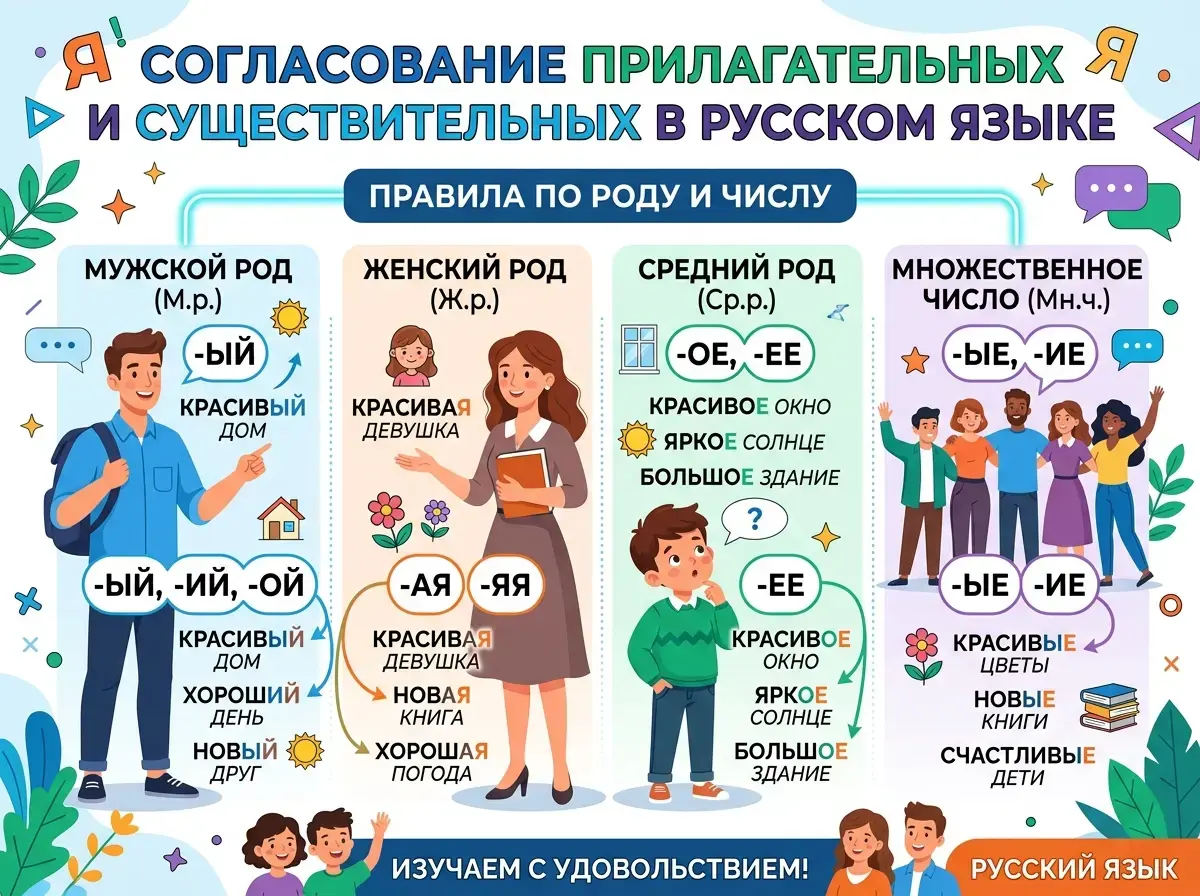
A Russian adjective agrees with its noun in gender, number and case. Compare новый телефон, новая сумка, новое письмо, новые книги — “a new phone, a new bag, a new letter, new books”. To choose an ending, identify the noun’s form first, then apply the adjective’s pattern. Agreement does not mean copying the noun’s ending.
Gender and number: the basic forms
The dictionary form is normally masculine singular nominative: новый, большой, синий. The table shows how these forms change when they describe a feminine noun, a neuter noun or a plural noun. In the plural, the adjective no longer distinguishes gender.
| Masculine | Feminine | Neuter | Plural |
|---|---|---|---|
| новый | новая | новое | новые |
| большой | большая | большое | большие |
| синий | синяя | синее | синие |
| русский | русская | русское | русские |
| хороший | хорошая | хорошее | хорошие |
Choose the noun’s gender, not the owner’s or speaker’s gender: мой новый телефон is the same whether a man or a woman owns it. Новый describes телефон. Likewise, masculine папа takes добрый папа despite ending in -а. An indeclinable noun still has gender: новое пальто, not новый пальто.
Hard and soft patterns: why -ий is not enough
The main models are новый — новая — новое and синий — синяя — синее. A stressed masculine ending is often -ой, as in большой. However, not every adjective ending in -ий follows синий: compare русский — русская — русское and хороший — хорошая — хорошее. Learn several forms, not just the final letters of the masculine form.
After г, к, х, ж, ч, ш, щ, write и rather than ы in the relevant endings: русский, тихий, хороший; русские, тихие, хорошие. After ж, ш, ч and щ, unstressed о in endings is written е: хорошее, хорошего, but stressed большое, большого. This produces mixed-looking forms; it does not make хороший behave exactly like синий.
Declension table: новый
Choose the case from the noun phrase’s role, verb or preposition. The adjective then takes that case too: к новому дому is dative; в новом доме is prepositional. The endings differ because nouns and adjectives have their own declension patterns.
| Case | Masculine | Feminine | Neuter | Plural |
|---|---|---|---|---|
| Nominative | новый | новая | новое | новые |
| Genitive | нового | новой | нового | новых |
| Dative | новому | новой | новому | новым |
| Accusative | новый / нового | новую | новое | новые / новых |
| Instrumental | новым | новой / новою | новым | новыми |
| Prepositional | о новом | о новой | о новом | о новых |
Masculine and neuter share most endings, but not nominative or accusative. Feminine новой can represent several cases; the construction tells you which: нет новой книги is genitive, к новой книге dative, с новой книгой instrumental. Новою is a valid longer instrumental variant. The two accusative options are explained below.
Declension table: синий
| Case | Masculine | Feminine | Neuter | Plural |
|---|---|---|---|---|
| Nominative | синий | синяя | синее | синие |
| Genitive | синего | синей | синего | синих |
| Dative | синему | синей | синему | синим |
| Accusative | синий / синего | синюю | синее | синие / синих |
| Instrumental | синим | синей / синею | синим | синими |
| Prepositional | о синем | о синей | о синем | о синих |
Compare нового — синего, новому — синему, новым — синим, новом — синем. The soft pattern has feminine синяя → синюю, not синяя → синую. Use complete examples: Я купила синюю папку — “I bought a blue folder”; Документы лежат в синей папке — “The documents are in the blue folder”.
In the endings -ого/-его, the letter г is normally pronounced like в: нового, синего. Keep г in writing. Pronunciation does not change the case or justify spelling these endings with в.
Accusative: animate or inanimate?
For masculine singular and all plural genders, the accusative adjective matches nominative with an inanimate noun and genitive with an animate noun. This is a choice of form: the phrase is still accusative.
| Pattern | Inanimate | Animate |
|---|---|---|
| Masculine singular | Я вижу новый магазин. | Я вижу нового соседа. |
| Plural | Я вижу новые магазины. | Я вижу новых соседей. |
| Feminine singular | Я вижу новую школу. | Я вижу новую соседку. |
| Neuter singular | Я вижу маленькое окно. | Я вижу маленькое животное. |
Feminine singular uses -ую/-юю regardless of animacy: новую школу, новую соседку. Neuter singular keeps -ое/-ее in the ordinary pattern: маленькое животное. Do not apply the masculine rule to every singular noun. In plural, the animacy contrast applies across genders: новые школы, but новых сотрудниц after вижу.
How to choose an ending in a sentence
Take Мы говорили о новой работе — “We talked about the new job”. Работа is feminine singular; о for a topic requires prepositional; the feminine prepositional of новый is новой. In Мы подошли к новому зданию, здание is neuter singular and к requires dative, so the adjective is новому. Start from the noun and construction, not from an isolated adjective question.
Full adjectives usually precede their nouns: интересная книга. They can also form a description after a noun: Эта книга интересная, “This book is interesting”. Full and short adjectives are not interchangeable in every construction. Книга интересна has a short form; short forms such as интересен, интересна, интересно, интересны are not declined through the tables above.
The tables describe ordinary full adjectives such as новый, синий and русский. Possessive adjectives such as мамин or лисий have additional patterns: лисья, лисье, лисьего. Do not apply the синий table to every word whose dictionary form ends in -ий.
Common mistakes and corrections
| Incorrect | Correct | Why |
|---|---|---|
| новый книга | новая книга | Книга is feminine. |
| русские язык | русский язык | Язык is masculine singular. |
| к новый дому | к новому дому | Dative after к. |
| вижу новый соседа | вижу нового соседа | Animate masculine accusative. |
| с хорошими другом | с хорошим другом | Другом is singular, not plural. |
| синяя папку | синюю папку | Feminine accusative: -юю. |