


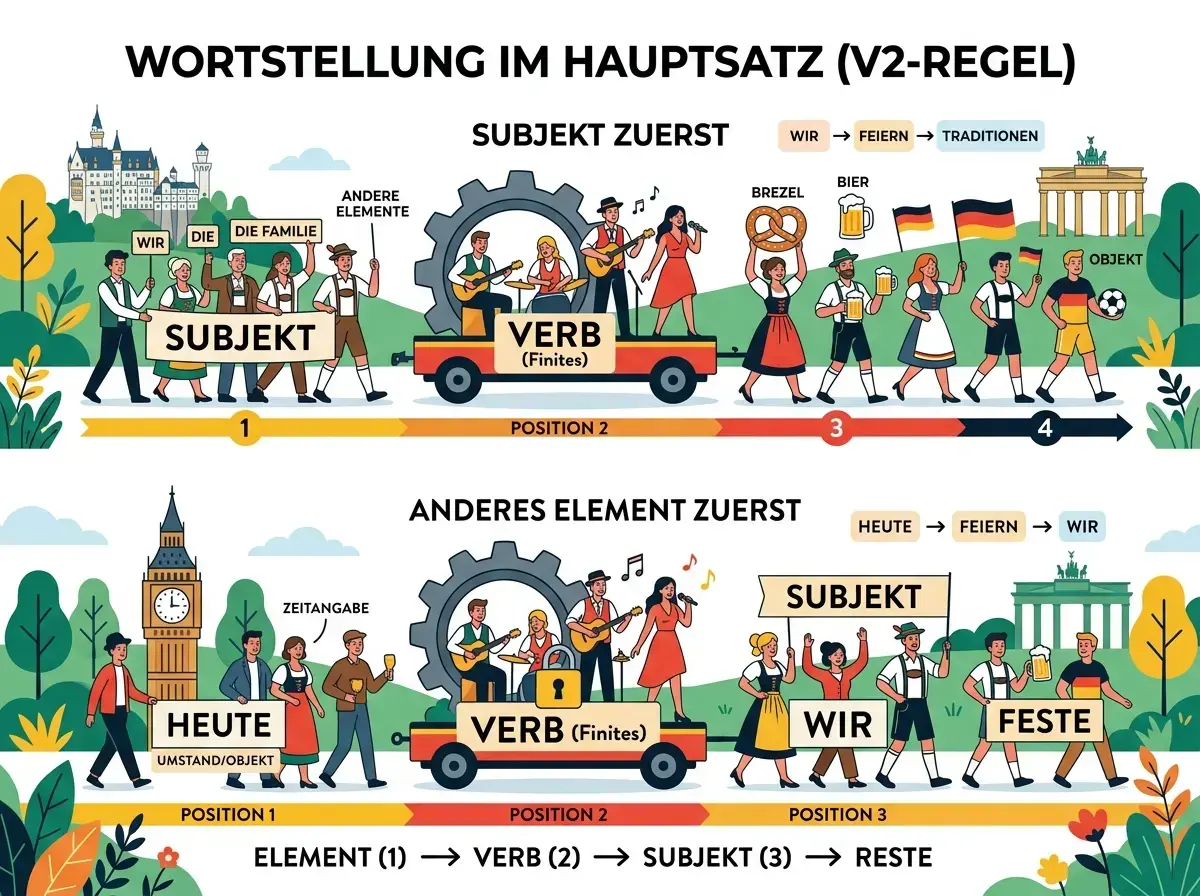
In a German statement, the conjugated verb occupies the second position. The sentence can start with the subject, a time expression or another element, but the verb keeps its place: Ich arbeite heute. Heute arbeite ich. When a verb has two parts, they usually form a bracket around the middle of the sentence. These two patterns explain most everyday German statements.
The verb comes second: count units, not words
The conjugated verb is the form that agrees with the subject: ich lerne, du lernst, wir lernen. It may be the main verb, an auxiliary such as haben or sein, or a modal verb such as können. “Second position” means after the first sentence unit. That unit can contain several words.
| First unit | Verb: position 2 | Rest of the sentence |
|---|---|---|
| Ich | lerne | jeden Abend Deutsch. |
| Jeden Abend | lerne | ich Deutsch. |
| Nach der Arbeit | lerne | ich Deutsch. |
| Meine neue Kollegin | lernt | auch Deutsch. |
Here, jeden Abend means “every evening”, nach der Arbeit means “after work”, and meine neue Kollegin means “my new colleague”. Each group fills just one position. The rule discussed here applies to ordinary statements; a yes/no question such as Lernst du Deutsch? starts with the verb.
Starting with something other than the subject
English allows “Tomorrow I am working at home.” German requires the verb before the subject when a time expression comes first: Morgen arbeite ich zu Hause. This is called inversion. Moving an element to the front makes it the starting point of your message; it does not automatically give it strong emphasis.
Den Koffer stellt Mia neben die Tür.
Mia puts the suitcase next to the door.
An object can also come first. Here den Koffer is accusative; Mia is still the subject. In simple examples the subject follows the verb immediately, but this is not an absolute third-position rule: Heute hat mir meine Kollegin geholfen. — “My colleague helped me today.” The unstressed pronoun mir precedes the noun subject.
The German sentence bracket
With a modal verb, the modal occupies position two and the main infinitive goes to the right-hand end of the bracket. In the perfect tense, haben or sein occupies position two and the past participle closes the bracket. Other sentence elements usually stand between them.
| First unit | Left bracket | Middle | Right bracket |
|---|---|---|---|
| Ich | muss | heute länger | arbeiten. |
| Wir | haben | gestern zusammen | gekocht. |
| Lea | ist | am Montag nach Bonn | gefahren. |
| Morgen | werde | ich die Unterlagen | schicken. |
| Um sieben | steht | Jonas | auf. |
The examples mean: “I have to work longer today”; “We cooked together yesterday”; “Lea went to Bonn on Monday”; “I will send the documents tomorrow”; “Jonas gets up at seven.” Notice that muss, haben, ist, werde and steht all occupy the same position, even though their grammatical jobs differ.
With separable verbs, the prefix closes the bracket: Ich rufe dich später an. — “I’ll call you later.” With a modal, the infinitive stays together: Ich muss dich später anrufen. — “I have to call you later.” Do not separate anrufen when it is an infinitive here.
The right bracket is not necessarily the last word of the whole sentence. A comparison can follow it: Lea hat heute länger gearbeitet als gestern. — “Lea worked longer today than yesterday.” Here gearbeitet closes the bracket and als gestern follows it.
Time, reason, manner and place: TeKaMoLo
When several adverbials occur in the middle of a sentence, a useful neutral order is time → reason → manner → place. The mnemonic TeKaMoLo comes from the German labels temporal, kausal, modal and lokal.
| Type | Question | Example |
|---|---|---|
| Te: time | When? | morgen |
| Ka: reason | Why? | wegen des Streiks |
| Mo: manner | How? By what means? | mit dem Auto |
| Lo: place or destination | Where? Where to? | nach Berlin |
Wir fahren morgen wegen des Streiks mit dem Auto nach Berlin.
We’re going to Berlin by car tomorrow because of the strike.
You do not need all four types. TeKaMoLo is a starting pattern, not a fixed slot system for every word. The verb’s complements, pronouns, emphasis and context also affect the order. You can move the reason to the front: Wegen des Streiks fahren wir morgen mit dem Auto nach Berlin. The conjugated verb still comes second.
Dative and accusative objects
With two noun objects, the neutral order is usually dative before accusative. An unstressed personal pronoun normally comes before a noun object. If both objects are unstressed personal pronouns, accusative comes before dative. These patterns apply within the middle of the sentence, not to an object already moved to the front.
| Pattern | Example |
|---|---|
| Noun + noun | Ich schicke meiner Schwester das Foto. |
| Dative pronoun + noun | Ich schicke ihr das Foto. |
| Accusative pronoun + noun | Ich schicke es meiner Schwester. |
| Accusative + dative pronouns | Ich schicke es ihr. |
The first example means “I’m sending my sister the photo.” Ihr replaces “my sister”; es replaces “the photo”. The last sentence means “I’m sending it to her.” Contrastive stress can produce other orders, so learn these as neutral patterns rather than as a ban on every alternative.
Where does nicht go?
Negation does not change the second-position rule. With a single main verb, nicht can close a simple sentence: Ich arbeite heute nicht. — “I’m not working today.” With a bracket, it can stand before the final verb part: Ich habe heute nicht gearbeitet. — “I didn’t work today.”
Do not turn this into “nicht always goes last”. It also stands before a predicative adjective: Das Zimmer ist nicht frei. — “The room isn’t available.” When a specific element is contrasted, nicht precedes that element: Ich fahre nicht am Freitag, sondern am Samstag. — “I’m travelling on Saturday, not Friday.” Its position depends on the construction and the scope of the negation.
Joining main clauses: aber or deshalb?
Coordinating conjunctions such as und, aber, oder and denn stand outside the second clause’s position count. A linking adverb such as deshalb or trotzdem does occupy the first position when placed at the start of that clause.
Es regnet, aber wir gehen spazieren.
It’s raining, but we’re going for a walk.
Es regnet, deshalb bleiben wir zu Hause.
It’s raining, so we’re staying at home.
After aber, wir fills position one and gehen position two. After the comma in the second example, deshalb fills position one and bleiben position two. You can also write aber heute bleiben wir zu Hause: the conjunction itself still does not occupy a position.
Keep this separate from a subordinate clause introduced by weil. In standard written German: Wir bleiben zu Hause, weil es regnet. — “We’re staying at home because it’s raining.” The main clause has verb-second order; the weil clause has its conjugated verb at the end.
Common word-order mistakes
| Incorrect | Correct | Reason |
|---|---|---|
| Heute ich lerne Deutsch. | Heute lerne ich Deutsch. | Verb second after a fronted time expression. |
| Ich muss arbeite heute. | Ich muss heute arbeiten. | The modal is conjugated; the infinitive closes the bracket. |
| Ich rufe an dich später. | Ich rufe dich später an. | The separable prefix closes the bracket. |
| Deshalb wir warten hier. | Deshalb warten wir hier. | Deshalb fills position one. |
To build a statement, first choose the opening unit, then put the conjugated verb in position two. Add the subject if it is not already first, place the remaining information in the middle, and close any verb bracket. Check object pronouns and negation separately: their positions cannot be decided by TeKaMoLo alone.