

Загрузка более ранних сообщений…
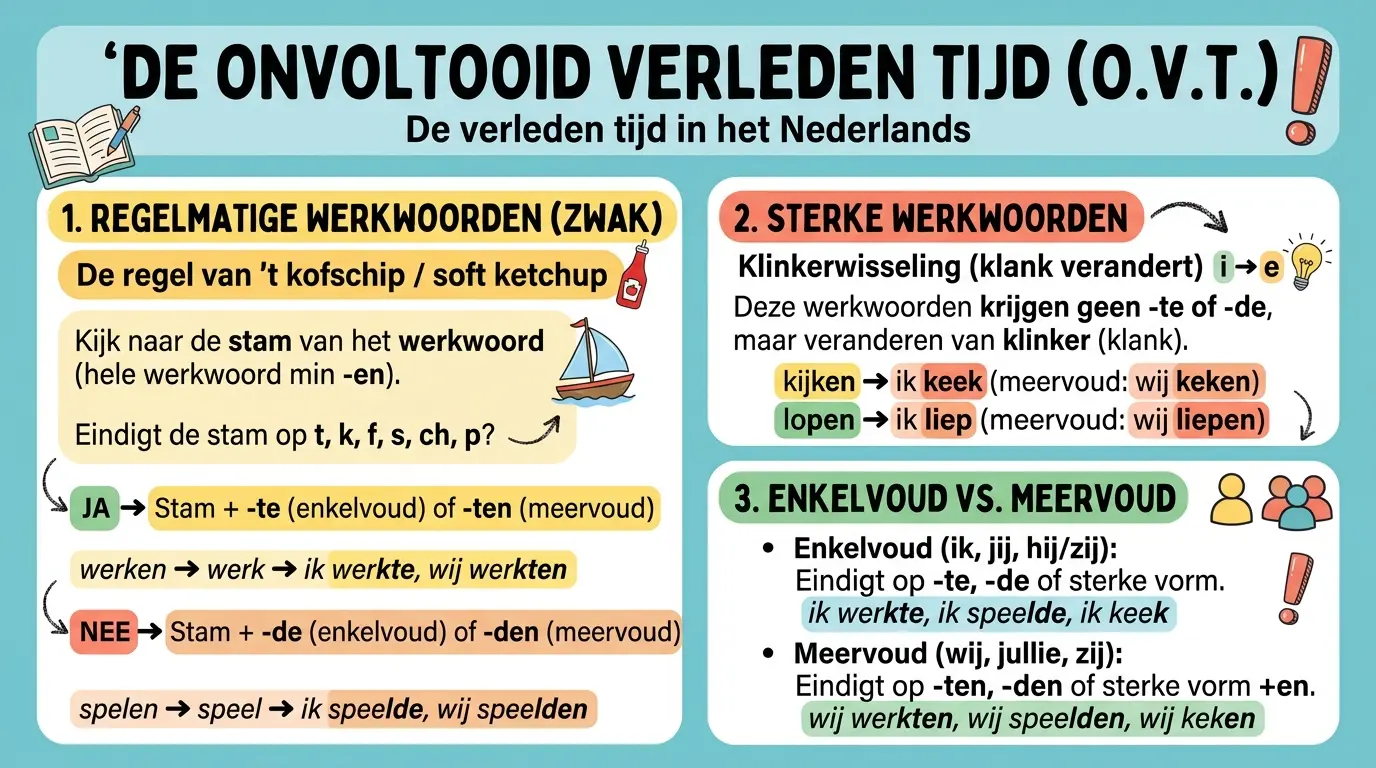
Imperfectum, also called onvoltooid verleden tijd (OVT), is the Dutch simple past. It describes past habits, situations and events in a story. Regular verbs take -te/-ten or -de/-den; other verbs have special forms such as ging, was and had. This article explains how to form the imperfectum and when to choose it rather than perfectum.
De winkel was nog dicht. Ik wachtte buiten en belde mijn collega.
The shop was still closed. I waited outside and called my colleague.
When do you use the imperfectum?
When using it, you take a past moment as your viewpoint: you describe what life was like then, what was happening or how a story developed. The main uses below show how that viewpoint works.
Past habits. Use the imperfectum to describe repeated behaviour in a past period. Words such as vroeger, toen and elke ochtend help establish that period or repetition: Toen ik in Arnhem woonde, fietste ik elke ochtend naar kantoor — “When I lived in Arnhem, I cycled to the office every morning”. The sentence describes a routine within that period.
Descriptions of a past scene. The imperfectum supplies the background: where someone was, what the surroundings were like and what was happening at the time. Ik liep langs de rivier. De zon scheen en er zaten mensen op het gras — “I was walking along the river. The sun was shining and people were sitting on the grass”. The description places you inside that scene.
Stories about the past. When describing a holiday or another past experience, the imperfectum lets you develop the account: Tijdens onze vakantie logeerden we in een klein hotel. Vanuit onze kamer zagen we de haven — “During our holiday, we stayed in a small hotel. From our room, we could see the harbour”. You are describing the experience as it was then.
Successive actions in a story. The imperfectum can move the story forward from one action to the next: Ik pakte mijn tas, sloot de deur en liep naar de halte — “I picked up my bag, closed the door and walked to the stop”. Here the verbs tell the sequence of events rather than describe a habit or background.
The imperfectum is also normal with frequent verbs expressing states or circumstances: zijn, hebben, weten, kunnen and moeten. A short answer can use it without a long story: Ik kon gisteren niet komen — “I could not come yesterday”. It is not a tense reserved for novels or formal writing.
Regular verbs: one singular and one plural form
In the ordinary imperfectum pattern, all singular subjects use the same form: ik werkte, jij werkte, u werkte, zij werkte. All plural subjects use the form with final n: wij werkten, jullie werkten, zij werkten. There is no separate third-person -t as there is in the present tense.
| Verb group | Singular: ik, jij, u, hij, zij, het | Plural: wij, jullie, zij |
|---|---|---|
| -te / -ten | stem + te: werkte | stem + ten: werkten |
| -de / -den | stem + de: belde | stem + den: belden |
For these regular verbs, use the correctly spelled ik-form as the base for the ending: maken → maak → maakte, bellen → bel → belde. Keep the long vowel in maak and remove the doubled consonant in bel. Choosing -te or -de is a separate step, explained below.
Choosing -te or -de with soft ketchup
For a regular verb, remove -en from the infinitive and check the final consonant before making spelling adjustments. If it is t, k, f, s, ch or p, use -te/-ten. With other consonants or a vowel, use -de/-den. The consonants in soft ketchup help you remember the first group; ch is one sound, not a rule for h on its own.
The underlying rule concerns sounds. That is why some loan verbs also take -te: mixen → mixte ends in the sound /s/ after /k/, and douchen → douchte ends in a voiceless “sh” sound. For everyday Dutch verbs, checking the infinitive as above is a practical starting point. Apply this method only after establishing that the verb has a regular past tense.
Why reisde and leefde have d
Do not choose the ending from the last letter of ik reis or ik leef. Their infinitives are reizen and leven, with z and v before -en. These belong to the -de group: reisde, reisden; leefde, leefden. The written base still has s or f, but the ending is chosen from the original consonant.
| Infinitive | Ik-form | imperfectum singular | imperfectum plural |
|---|---|---|---|
| werken | werk | werkte | werkten |
| maken | maak | maakte | maakten |
| bellen | bel | belde | belden |
| reizen | reis | reisde | reisden |
| leven | leef | leefde | leefden |
| wachten | wacht | wachtte | wachtten |
| melden | meld | meldde | meldden |
If the base ends in t or d, retain that letter and add the whole ending: wacht + te = wachtte, meld + de = meldde. Double tt or dd is correct here. Compare wij wachten — “we wait” — and wij wachtten — “we waited”: the spelling distinguishes the tenses even when the pronunciation sounds the same.
Irregular verbs: learn the singular and plural together
Many frequent verbs do not form their past with ordinary -te or -de. Some change the vowel, such as kijken → keek; others have a more distinctive form, such as gaan → ging. Learn three forms together: infinitive — imperfectum singular — imperfectum plural. The following is a useful core list, not an exhaustive list of Dutch irregular verbs.
| Infinitive | Singular | Plural |
|---|---|---|
| zijn | was | waren |
| hebben | had | hadden |
| gaan | ging | gingen |
| komen | kwam | kwamen |
| doen | deed | deden |
| zien | zag | zagen |
| weten | wist | wisten |
| worden | werd | werden |
| krijgen | kreeg | kregen |
| geven | gaf | gaven |
| nemen | nam | namen |
| vinden | vond | vonden |
| denken | dacht | dachten |
| kopen | kocht | kochten |
| brengen | bracht | brachten |
| spreken | sprak | spraken |
| lezen | las | lazen |
| schrijven | schreef | schreven |
| staan | stond | stonden |
| zitten | zat | zaten |
| liggen | lag | lagen |
| kunnen | kon | konden |
| mogen | mocht | mochten |
| moeten | moest | moesten |
| willen | wilde | wilden |
| zullen | zou | zouden |
Willen is included because it is frequently needed, but wilde/wilden follows the regular -de pattern; wou is also a correct singular alternative. With a modal verb, put the modal in the imperfectum and leave the other verb in the infinitive: We moesten de afspraak verplaatsen — “We had to reschedule the appointment”. Zou/zouden has additional uses, including hypothetical meaning; it does not always describe something that actually happened.
Do not add en blindly to a written singular form. Some plurals need a spelling change: kwam → kwamen, keek → keken, las → lazen. With zijn, learn the contrast was → waren separately. As with regular verbs, the plural form goes with wij, jullie and plural zij/ze.
Word order in statements, questions and subordinate clauses
The imperfectum changes the verb form, not the basic word-order rules. In a main statement, the conjugated verb takes the second position: Gisteren belde ik de verhuurder — “Yesterday I called the landlord”. In a yes/no question, it comes first: Belde je de verhuurder? Unlike the present-tense -t, the imperfectum ending stays unchanged when jij/je follows the verb.
In a subordinate clause with one verb, put that verb towards the end: Ik bleef thuis omdat ik koorts had — “I stayed at home because I had a fever”. For a separable verb, the prefix separates in the main clause and joins the verb in the subordinate clause. The imperfectum itself does not add ge-: that prefix belongs to many past participles, not to simple-past forms.
De monteur belde me terug. Ik was blij dat de monteur me terugbelde.
The technician called me back. I was glad that the technician called me back.
Imperfectum or perfectum: what is the difference?
The imperfectum describes the past from a past viewpoint. You place yourself at the time of the situation and tell what was happening or how events unfolded. Perfectum looks back on a situation or event as finished by now. Compare Ik werkte in een boekwinkel — “I worked in a bookshop”, introducing a past situation — with Ik heb in een boekwinkel gewerkt — “I have worked in a bookshop”, presenting that period as a completed experience. The choice depends on what you want to say in the surrounding conversation.
| imperfectum | Perfectum | Form difference |
|---|---|---|
| Ik werkte thuis. | Ik heb thuis gewerkt. | werkte ↔ heb + gewerkt |
| Zij ging naar buiten. | Zij is naar buiten gegaan. | ging ↔ is + gegaan |
| Wij belden de klant. | Wij hebben de klant gebeld. | belden ↔ hebben + gebeld |
A time word such as gisteren does not decide between these tenses. Gisteren werkte ik thuis describes yesterday’s situation; Gisteren heb ik thuis gewerkt reports that period of work retrospectively as finished. Both can describe the same actual day. The distinction is how the speaker presents the past, not a guarantee that an event in the imperfectum has no consequences today.
The two tenses often work together: introduce an event in perfectum, then describe its circumstances in the imperfectum. The change has a purpose; it is not an error simply because both tenses appear in one short account.
Ik heb zaterdag een cursus gevolgd. De groep was klein en de docent legde alles rustig uit.
I took a course on Saturday. The group was small and the teacher explained everything calmly.
Common imperfectum mistakes
| Instead of… | Use… | Why? |
|---|---|---|
| Ik reiste alleen. | Ik reisde alleen. | Reizen has z before -en. |
| Ik wachte buiten. | Ik wachtte buiten. | Keep the stem’s t: wacht + te. |
| Wij belde de klant. | Wij belden de klant. | Plural subject: add -n. |
| Zij gingde naar buiten. | Zij ging naar buiten. | Ging is already the past form. |
| Werk jij gisteren thuis? | Werkte jij gisteren thuis? | In the imperfectum, inversion keeps the ending. |
| Ik heb gisteren werkte. | Ik heb gisteren gewerkt. | Heb + participle is perfectum; the imperfectum is ik werkte. |