
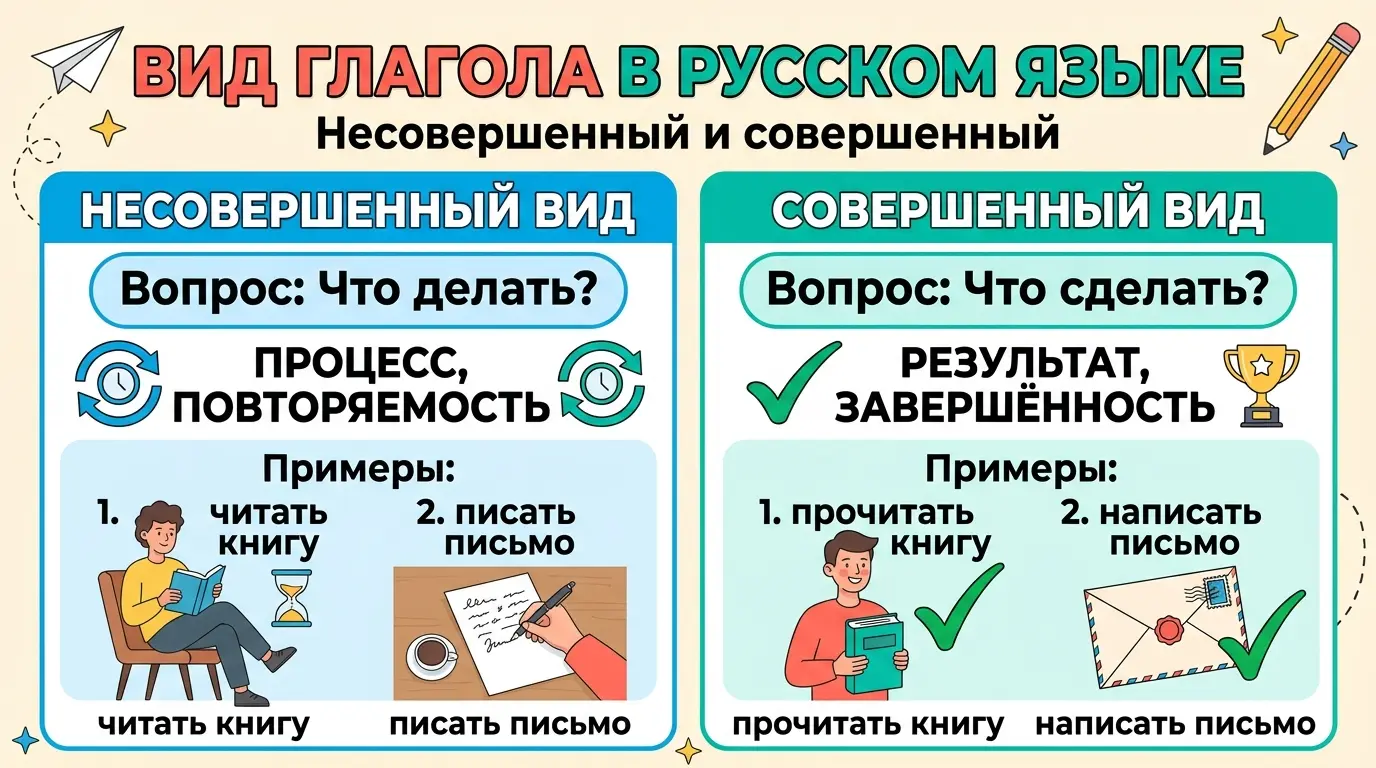
Russian verb aspect shows how the speaker presents an action: as a process, a repeated activity or a fact, or as a whole event with a boundary. Compare Я читал статью — “I was reading / read the article” and Я прочитал статью — “I read the article through”. The first sentence does not tell you whether the reading was completed; the second presents completion. These are different aspects, not different tenses.
Imperfective and perfective: the basic distinction
| Aspect | Russian question | Typical focus | Examples |
|---|---|---|---|
| Imperfective: несовершенный вид (НСВ) | что делать? | Process, repetition, state or the fact of an action. | читать, писать, решать |
| Perfective: совершенный вид (СВ) | что сделать? | An event taken as a whole, often with an attained result. | прочитать, написать, решить |
The questions help identify the aspect of a known verb, but they do not choose the right aspect for your message. Start with what you mean: an activity in progress, a habit, an experience, or a particular outcome. Imperfective does not mean “never finished”, and perfective does not mean “short”. An action lasting several years can be perfective: Они построили дом за три года — “They built the house in three years”.
When to use the imperfective
Process, background and repetition
Use imperfective when looking at an action from within: В семь часов я готовил ужин — “At seven I was cooking dinner”. It also describes background alongside another event: Я готовил ужин, когда позвонил сосед — “I was cooking dinner when a neighbour called”. Готовил presents the ongoing activity; позвонил presents the call as an event.
Imperfective is the usual choice for routines: По пятницам она покупала цветы — “She used to buy flowers on Fridays”. Each purchase may have been completed; the sentence focuses on repetition. States are also commonly imperfective: Я знал адрес — “I knew the address”. They do not need an unfinished task to qualify as imperfective.
An experience or the fact that something happened
Ты смотрел этот фильм? asks “Have you seen this film?” It asks about experience, not whether someone stopped halfway through. Кто готовил этот суп? — “Who made this soup?” — can be asked while eating the finished soup. This factual use is a central reason why “imperfective = unfinished” fails.
When to use the perfective
Use perfective to present a specific result: Я отправил заявку — “I sent the application”. The sending is presented as accomplished. In a narrative, a sequence of perfective verbs often moves events forward: Она открыла письмо, прочитала адрес и вызвала такси — “She opened the letter, read the address and called a taxi”.
A boundary can also be a beginning or a limited period: Он заговорил — “He started speaking”; Мы немного поговорили — “We talked for a while”. Neither means that the entire possible activity of speaking was “finished”. Nor must a perfective result still hold now: Утром я открыл окно, а потом закрыл его — “I opened the window in the morning and later closed it”.
Aspect and tense: present, past and future
| Tense | Imperfective: читать | Perfective: прочитать |
|---|---|---|
| Present | я читаю | No present-tense form |
| Past | я читал / читала | я прочитал / прочитала |
| Future | я буду читать | я прочитаю |
Only imperfective verbs have a present tense. Прочитаю may look like a present-tense form, but it is future. For the imperfective future, conjugate быть and keep the infinitive: буду, будешь, будет, будем, будете, будут читать. The perfective future uses one conjugated verb: прочитаю, прочитаешь, прочитает, прочитаем, прочитаете, прочитают. Do not combine буду with прочитать.
Compare Завтра я буду писать отчёт — “Tomorrow I will be working on the report” — and Завтра я напишу отчёт — “Tomorrow I will write the report”. The first plans the activity; the second presents completion as the intended outcome. Neither the word завтра nor the future tense by itself determines aspect.
Aspect pairs: learn the verbs together
Many verbs form a pair with the same basic lexical meaning but a different aspect. A prefix may create the perfective, a suffix may create the imperfective, or the stems may differ considerably. There is no single prefix you can add to every verb.
| Imperfective | Perfective | Meaning |
|---|---|---|
| делать | сделать | do, make |
| читать | прочитать | read |
| писать | написать | write |
| решать | решить | solve; decide |
| открывать | открыть | open |
| покупать | купить | buy |
| получать | получить | receive |
| брать | взять | take |
| говорить | сказать | say, in the meaning of conveying a message |
The meaning matters: говорить — сказать is useful for “say something”, but говорить also means “speak”, as in говорить по-русски; сказать is not its universal replacement. A prefix can add a new lexical meaning: писать → переписать means “rewrite”, whose imperfective partner is переписывать. Some verbs, such as принадлежать, have no ordinary aspect partner. Learn the pair in a phrase, not as an automatic spelling operation.
Time expressions: useful clues, not automatic rules
| Example | What it highlights |
|---|---|
| Я читал статью двадцать минут. | Duration of reading; completion is not asserted. |
| Я прочитал статью за двадцать минут. | Time needed to finish the article. |
| Мы поговорили двадцать минут и разошлись. | A bounded conversation can also have a duration. |
| Я три раза перечитал сообщение. | Three completed readings, presented as a counted set. |
Часто, обычно and каждый день often accompany imperfective habits; за час often measures time to a perfective result. But a duration does not prohibit perfective, and repetition does not always require imperfective. Distinguish an open-ended habit from a counted set of completed events.
Negation and infinitives: two practical contrasts
Negation does not automatically select imperfective. Я не читал инструкцию says that reading it did not take place in the relevant context. Я не прочитал инструкцию до конца says that completion was not reached; some reading may have happened. Likewise, Я ещё не отправил письмо focuses on a result that has not been achieved yet.
After verbs of beginning, continuing or stopping, the dependent infinitive is imperfective: начал читать, продолжает писать, перестал работать. The first verb may itself be perfective: начал is perfective, but читать stays imperfective. After хочу, both aspects are possible: Я хочу читать describes the desired activity; Я хочу прочитать эту статью points to completing a particular reading task.
Quick reference: what changes with aspect?
| Imperfective | Perfective | Difference |
|---|---|---|
| Я решал задачу. | Я решил задачу. | Working on it / reaching a solution. |
| Ты читал это письмо? | Ты прочитал это письмо? | Asking about reading as a fact / asking about completed reading. |
| Я буду готовить ужин. | Я приготовлю ужин. | Planning the activity / presenting a finished dinner as the intended result. |
English tense labels do not map directly onto Russian aspect: “I have seen that film” can use imperfective смотрел, while “I opened the window yesterday” can use perfective открыл. Choose aspect from the meaning of the Russian sentence, then choose the tense form.