
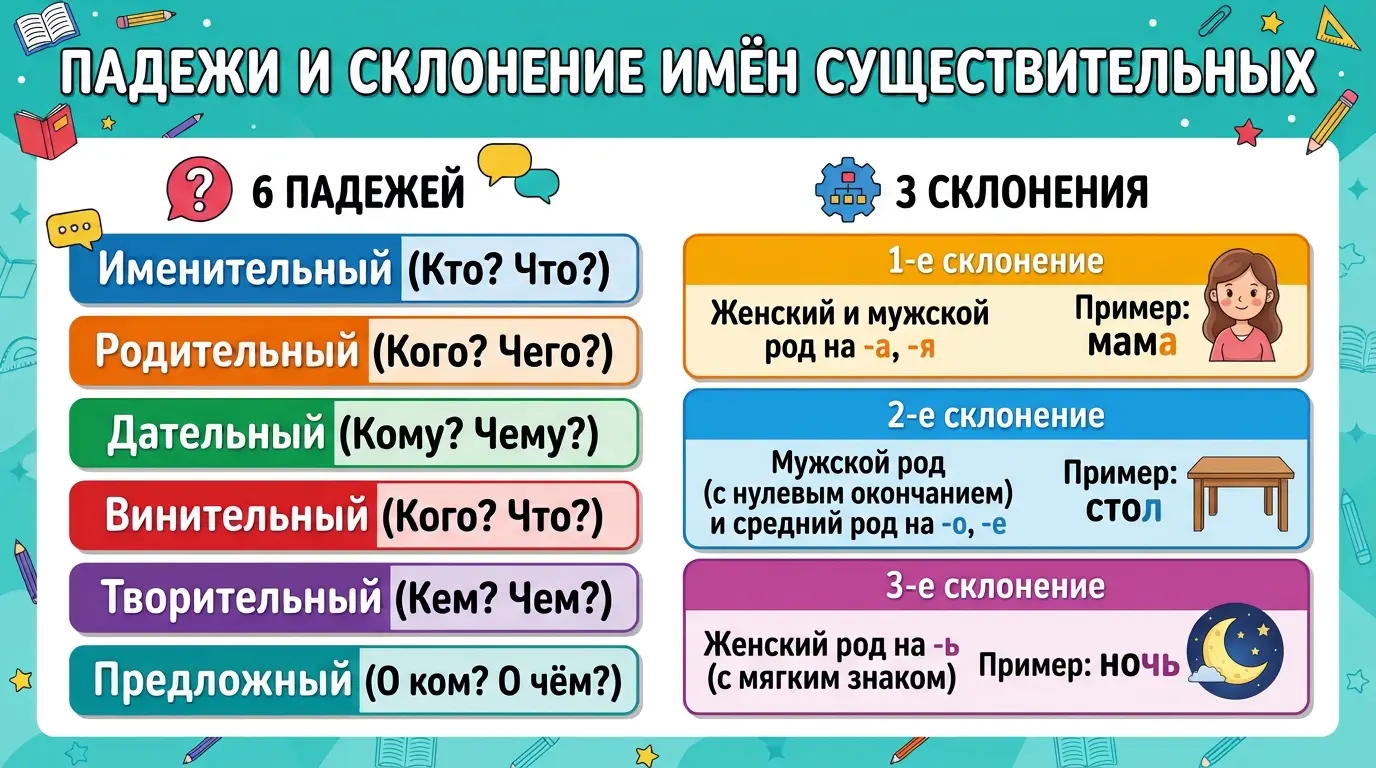
Russian cases show the role of a noun in a sentence. The same word changes form depending on whether it names the subject, an object, a recipient or another relationship: книга — книгу — в книге. Declension is the pattern of these changes. To choose a form, first identify the required case, then apply the noun’s declension pattern and number.
The six Russian cases at a glance
| Case | Questions | Typical role |
|---|---|---|
| Nominative — Именительный | кто? что? | Subject; dictionary form. |
| Genitive — Родительный | кого? чего? | Possession, absence, quantity; after many prepositions. |
| Dative — Дательный | кому? чему? | Recipient, experiencer; after certain verbs and prepositions. |
| Accusative — Винительный | кого? что? | Direct object; destination with в/на. |
| Instrumental — Творительный | кем? чем? | Instrument, companion, role with certain verbs. |
| Prepositional — Предложный | о ком? о чём? | Topic; location with в/на. Always used with a preposition. |
These questions help name a case once you understand the construction; they are not a complete method for choosing one. Кого? belongs to both genitive and accusative. A verb or preposition often determines the case: помогать другу uses dative, while видеть друга uses accusative. Друга matches the genitive form, but its role here is determined by the sentence. Learn the whole phrase rather than translating a question mechanically.
What each case does in a sentence
Nominative: the subject
Курьер привёз посылку — “The courier delivered a parcel”. Курьер is the subject and stays in the nominative; посылку is the object. Reversing their order does not automatically reverse their roles: Посылку привёз курьер still says the courier delivered it, now with emphasis on who did it. Russian word order has meaning even though endings identify the roles.
Genitive: possession, absence and quantity
Compare ключ соседки — “the neighbour’s key”, нет билета — “there is no ticket”, and чашка чая — “a cup of tea”. The genitive also follows prepositions such as без, для, из and у: без сахара, “without sugar”. In У сестры есть машина, сестры is genitive after у, while машина is nominative.
Dative: the recipient and the person experiencing a state
Я отправил коллеге сообщение means “I sent my colleague a message”: коллеге is the recipient. Dative also appears in Брату холодно — “My brother is cold”, and after к: к врачу — “to the doctor”. Learn verb patterns such as помогать соседу and звонить клиенту with the dative form.
Accusative: the direct object and destination
Я читаю статью — “I’m reading an article” — uses accusative for the direct object. With в and на, it can mark a destination: Мы идём в библиотеку, “We’re going to the library”. Animacy affects some accusative forms; this is explained below.
Instrumental: means, company and role
Compare писать карандашом, “to write with a pencil”, and говорить с коллегой, “to talk with a colleague”. The instrument normally needs no с; companionship does. Instrumental also follows certain verbs: Она работает переводчиком, “She works as a translator”. Do not use this ending for every noun that names a profession: Она переводчик has nominative.
Prepositional: location and topic
This case always has a preposition: в квартире, “in the apartment”, на работе, “at work”, о поездке, “about the trip”. Other cases can also follow prepositions, so the name “prepositional” does not mean “the case after every preposition”.
Three main noun declension patterns
In the traditional school classification, a noun’s gender and nominative singular form determine its main declension type. Gender alone is not enough: masculine папа follows the first pattern, while masculine стол follows the second. A final ь does not identify gender: день is masculine, тетрадь is feminine.
| Type | Nominative singular | Examples |
|---|---|---|
| 1 | Nouns in -а/-я, mostly feminine, also masculine and common gender. | книга, неделя, папа, коллега |
| 2 | Masculine with zero ending; neuter in -о/-е, including -ё. | стол, музей, день; окно, море, ружьё |
| 3 | Feminine with zero ending, written with final ь. | тетрадь, ночь, дверь |
Singular declension table
These four inanimate model nouns show common patterns. Learn the complete forms and their stress, not just detached endings. Soft stems and special endings have variations, so this table is a foundation rather than a rule for every noun.
| Case | стол | кни́га | окно́ | тетра́дь |
|---|---|---|---|---|
| Nominative — Именительный | стол | кни́га | окно́ | тетра́дь |
| Genitive — Родительный | стола́ | кни́ги | окна́ | тетра́ди |
| Dative — Дательный | столу́ | кни́ге | окну́ | тетра́ди |
| Accusative — Винительный | стол | кни́гу | окно́ | тетра́дь |
| Instrumental — Творительный | столо́м | кни́гой | окно́м | тетра́дью |
| Prepositional — Предложный | о столе́ | о кни́ге | об окне́ | о тетра́ди |
The instrumental feminine also has longer variants such as книгою; the table uses the common shorter form. After г, к, х, ж, ч, ш, щ, write и instead of ы in these endings: книга → книги. For words in -ия, note станция → к станции, о станции; words in -ий/-ие have prepositional -ии: о санатории, о здании.
Plural declension table
| Case | столы́ | кни́ги | о́кна | тетра́ди |
|---|---|---|---|---|
| Nominative — Именительный | столы́ | кни́ги | о́кна | тетра́ди |
| Genitive — Родительный | столо́в | книг | о́кон | тетра́дей |
| Dative — Дательный | стола́м | кни́гам | о́кнам | тетра́дям |
| Accusative — Винительный | столы́ | кни́ги | о́кна | тетра́ди |
| Instrumental — Творительный | стола́ми | кни́гами | о́кнами | тетра́дями |
| Prepositional — Предложный | о стола́х | о кни́гах | об о́кнах | о тетра́дях |
The plural dative, instrumental and prepositional commonly use -ам/-ям, -ами/-ями, -ах/-ях. The genitive plural is less predictable: compare столов, книг, окон and тетрадей. You cannot form every genitive plural by adding -ов, and the stem can change as well as the ending.
Animacy and the accusative
In the plural, animate nouns normally use an accusative matching the genitive; inanimate nouns use one matching the nominative: вижу студентов, “I see students”, but вижу столы, “I see tables”. In singular masculine nouns of the second declension, the same contrast applies: вижу студента / вижу стол.
Do not apply “animate = genitive form” to every singular noun. First-declension singular nouns have -у/-ю: вижу сестру, вижу папу; feminine тетрадь keeps its form in the accusative. Animacy is a grammatical category, not simply a test of biological life: plants are normally inanimate, as in вижу деревья.
Prepositions: where or where to?
With spatial в/на, a destination usually takes accusative and a location takes prepositional: иду в школу / учусь в школе. Do not simplify this to “movement always needs accusative”: гуляю в парке describes movement within a location and uses prepositional. The particular preposition and meaning matter.
A single preposition can take different cases: с другом means “with a friend” and uses instrumental; со стола means “off/from the table” and uses genitive. Learn prepositions together with a meaning and case, not as isolated translations.
Exceptions and agreement: what the basic tables do not cover
Some nouns do not change their visible form: новое метро — около метро — в метро. They still have a case in the sentence. Others have special patterns, such as время — времени or мать — матери. A few location forms differ from the usual prepositional: о лесе but в лесу. Learn these as additional forms, not as endings to apply to every noun.
Adjectives and many pronouns agree with the noun, but use their own endings: новая книга → нет новой книги → с новой книгой. Do not copy the noun’s ending onto the adjective. For each phrase, choose the case first, then change every word that must agree with the noun.