




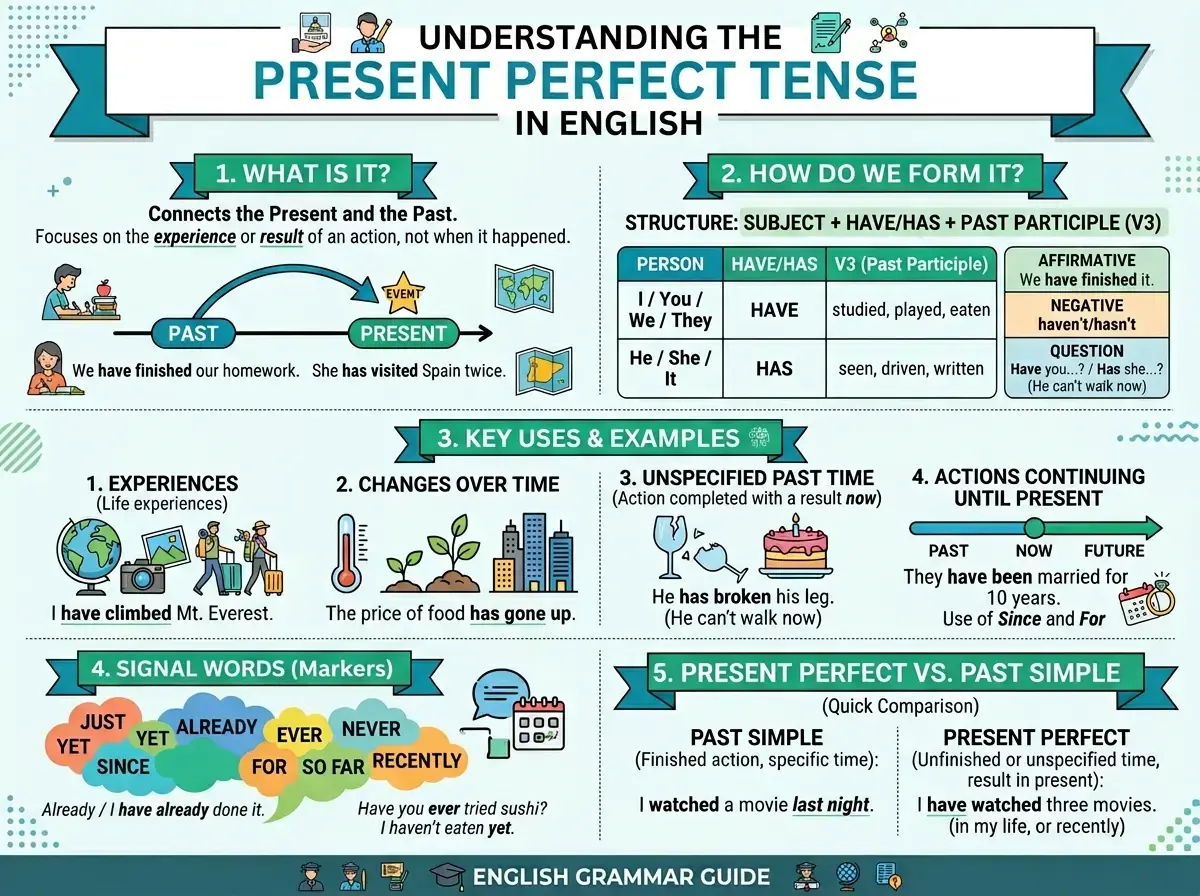
The Present Perfect connects an earlier event or situation with the present. Use it for experience up to now, a past event with a current result, events within an unfinished period, and situations that began earlier and still continue. The form is have/has + past participle: I have finished, She has arrived. Despite its name, it does not always mean that an action or situation is finished.
How to form the Present Perfect
Use have with I, you, we and they; use has with he, she, it and singular noun subjects. The past participle stays the same for every subject. Regular verbs usually form it with -ed; irregular verbs have forms you need to learn. Unlike some other languages, English uses have here even with arrive, go and become: She has arrived, not “She is arrived”.
| Subject | Affirmative | Negative | Question |
|---|---|---|---|
| I / you / we / they | They have finished. | They have not finished. | Have they finished? |
| he / she / it | She has finished. | She has not finished. | Has she finished? |
Common contractions are I’ve, you’ve, we’ve, they’ve, he’s, she’s, it’s. In She’s finished the report, ’s means has. In She’s tired, it means is. Read the whole construction: an apostrophe alone does not tell you the tense.
Past participles: finished, seen, written
With regular verbs, check spelling: work → worked, live → lived, study → studied, stop → stopped. After vowel + y, keep y: play → played. With irregular verbs, the past simple and participle may be different: I saw it, but I have seen it. The participle is often called the third form or V3.
| Base form | Past Simple | Past participle |
|---|---|---|
| be | was / were | been |
| go | went | gone |
| see | saw | seen |
| write | wrote | written |
| take | took | taken |
| do | did | done |
| have | had | had |
| buy | bought | bought |
| make | made | made |
| read | read /red/ | read /red/ |
Experience up to now
Use the Present Perfect to ask or say whether something has happened in a person’s experience up to now, without placing the event at a finished past time: Have you ever worked abroad?, I’ve visited Lisbon twice. Ever means “at any time” in this kind of question; never means “at no time”: I’ve never driven an electric car. Do not add not to never for the same negation.
Once you ask when it happened, normally switch to the Past Simple: When did you visit Lisbon? — I went there in 2022. A finished biographical period also takes the Past Simple: My grandfather visited Lisbon twice during his childhood. It is the time frame, not the number of experiences, that matters.
A past event with a current result
The Present Perfect can announce a change or event whose result matters now: I’ve lost my access card suggests that I cannot currently find or use it; The delivery has arrived announces that it is now here. The exact past time is not the focus.
A current consequence does not automatically require the Present Perfect. I lost my access card yesterday, so I can’t get in is correct: yesterday locates the loss in a finished past time, even though the consequence continues.
An unfinished period: today, this week, so far
Use the Present Perfect to count or report events during a period that extends to now: We’ve received five orders today, She has completed three lessons so far. Today and this week are not automatic tense markers: a speaker can use the Past Simple for a finished event within them. I saw Ben this morning is natural when the morning is over.
Since and for: situations that still continue
With states and some continuing situations, the Present Perfect links a starting point in the past to now: I’ve known Elena for ten years, We’ve lived here since 2020. These sentences normally mean that the relationship or situation still continues. Do not use the Present Simple to express the same duration up to now.
| Word | Meaning | Examples |
|---|---|---|
| since | Starting point | since Monday; since 2020; since I moved here |
| for | Duration | for three hours; for six months; for a long time |
Ask about duration with How long have you lived here? For is not exclusive to the Present Perfect: I lived there for three years describes a finished period in the Past Simple. For continuing activities, the Present Perfect Continuous is often natural: I’ve been waiting for an hour. State verbs such as know normally use the simple perfect: I’ve known her for years.
Already, yet, just, ever and never
| Word | Typical meaning and position | Example |
|---|---|---|
| already | Before now, often earlier than expected; usually before the participle. | We have already booked the tickets. |
| yet | Up to now; usually at the end of questions and negatives. | Have you paid yet? / I haven’t paid yet. |
| just | A short time ago; between have/has and the participle. | She has just called. |
| ever / never | At any time / at no time; normally before the participle. | Have you ever tried it? / I have never tried it. |
These words do not force the Present Perfect in every sentence. American English commonly uses the Past Simple with just, already and yet in contexts where British English often prefers the Present Perfect: I just ate, Did you finish yet? Such forms are not automatically mistakes.
Questions, negatives and short answers
For a negative, put not after have/has: We haven’t received the invoice. For a question, put have/has before the subject: Has the train left? Do not add do, does or did. In short answers, repeat have or has and use the appropriate pronoun.
| Question | Yes | No |
|---|---|---|
| Have you finished? | Yes, I have. | No, I haven’t. |
| Has Sam replied? | Yes, he has. | No, he hasn’t. |
| Have the guests arrived? | Yes, they have. | No, they haven’t. |
An affirmative short answer ends with the full auxiliary: Yes, I have, not “Yes, I’ve”. With a question word, keep the same order: What have you changed? If who is the subject, it comes first: Who has opened the window?
Been to or gone to?
Has been to normally describes a completed visit: Nina has been to the bank means she went and has returned. Has gone to means she has left for that place and has not returned: Nina has gone to the bank. She may still be on the way or already there. For a continuing stay, use in: She has been in Rome for a week.
Present Perfect or Past Simple?
Use the Past Simple when you place a past event at a definite finished time: yesterday, last Friday, in 2019, two days ago. Use the Present Perfect when the frame extends to now or the event is presented through its present relevance without that finished past-time setting. Recency alone is not the rule: an event five minutes ago can be Past Simple, and an experience years ago can be Present Perfect.
| Present Perfect | Past Simple |
|---|---|
| I have sent the application. | I sent the application yesterday. |
| We have lived here for five years. | We lived there for five years before moving. |
| Have you ever met the director? | Did you meet the director at last week’s event? |
Common Present Perfect mistakes
| Incorrect in this meaning | Correct | Reason |
|---|---|---|
| She have finished. | She has finished. | Has with she. |
| I have wrote to him. | I have written to him. | Use the past participle. |
| Did you have seen it? | Have you seen it? | No did in a Present Perfect question. |
| I have called her yesterday. | I called her yesterday. | Finished past-time reference. |
| We have lived here since three years. | We have lived here for three years. | For + duration. |