




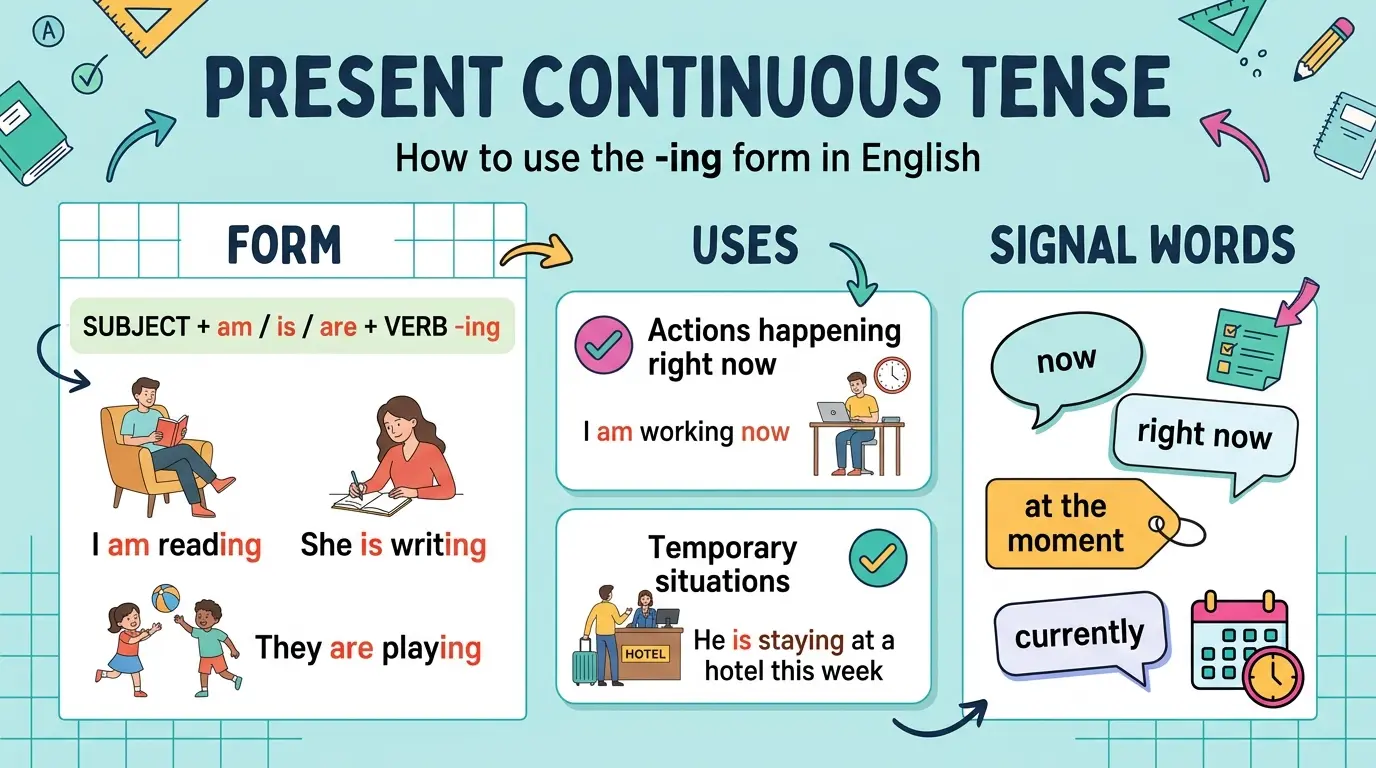
The Present Continuous, also called the Present Progressive, describes an activity in progress, a temporary situation or a developing change. Its form is am/is/are + verb-ing: I am working. It can refer to this moment, a period around now or an arranged future event. The meaning comes from the situation, not simply from the word now.
When do you use the Present Continuous?
Use it for an action happening at the moment of speaking: Please wait. I’m checking your booking. It also describes a current activity that is not happening at this exact second: I’m reading a book about architecture can be true while you are talking rather than reading.
| Use | Example | Meaning |
|---|---|---|
| Action now | The receptionist is talking to a guest. | The conversation is in progress. |
| Activity around now | We are preparing a new course. | The project is currently under way. |
| Temporary situation | She is staying with her sister this month. | A temporary living arrangement. |
| Change or development | The days are getting shorter. | A change is taking place. |
| Future arrangement | I am meeting the designer on Thursday. | A meeting has been arranged. |
Temporary does not mean “lasting only a few minutes”. She is working abroad this year presents a year-long situation as temporary. The speaker’s perspective matters more than the number of hours or days.
How to form it: am, is or are + -ing
Both parts are necessary: a present form of be and an -ing form. Be agrees with the subject; the -ing form stays the same. Use am with I, is with he/she/it and a singular noun, and are with you/we/they and plural nouns.
| Subject | Full form | Contraction |
|---|---|---|
| I | I am waiting. | I’m waiting. |
| he / she / it | She is waiting. | She’s waiting. |
| you / we / they | They are waiting. | They’re waiting. |
Do not add -s to the -ing form: He is working, not “He is workings”. Do not omit be: They are studying, not “They studying”. A sentence such as She is tired is not Present Continuous: tired is an adjective here, and there is no -ing verb.
Spelling rules for -ing
| Rule | Examples |
|---|---|
| Usually add -ing | work → working; play → playing; study → studying |
| Drop a final silent -e | make → making; write → writing |
| Keep -ee; also remember being | see → seeing; agree → agreeing; be → being |
| Change -ie to -y | lie → lying; tie → tying; die → dying |
| Double the final consonant in short consonant–vowel–consonant words | sit → sitting; run → running; stop → stopping |
| In longer words, check final-syllable stress | begin → beginning; prefer → preferring; visit → visiting |
Do not double final w, x or y: snowing, fixing, playing. Do not double after two vowel letters: read → reading. British and American spelling sometimes differs: travelling is usual in British English, traveling in American English. Keep your chosen variety consistent.
Negatives: put not after be
Use subject + am/is/are + not + verb-ing. Do not add do or does: be already serves as the auxiliary. With I, the usual contraction is I’m not. With is and are, both contraction patterns are possible: she isn’t / she’s not; they aren’t / they’re not.
| Full form | Contraction |
|---|---|
| I am not driving today. | I’m not driving today. |
| She is not using the printer. | She isn’t using the printer. / She’s not using the printer. |
| They are not staying overnight. | They aren’t staying overnight. / They’re not staying overnight. |
Questions and short answers
Put be before the subject: Am/Is/Are + subject + verb-ing? For a specific question, put the question word first: What are you doing?, Why is she leaving? When who is the subject, it comes before be: Who is using my charger? No do or does is needed in any of these patterns.
| Question | Affirmative answer | Negative answer |
|---|---|---|
| Are you listening? | Yes, I am. | No, I’m not. |
| Is Maya coming? | Yes, she is. | No, she isn’t. |
| Are they waiting outside? | Yes, they are. | No, they aren’t. |
In a short answer, repeat be, not the -ing verb. An affirmative short answer ends with the full form: Yes, she is, not “Yes, she’s”. The pronoun follows the meaning: Are you…? normally receives I am… from one person answering.
Present Continuous or Present Simple?
The Present Simple presents habits, facts and states; the Present Continuous presents activities in progress and temporary situations. Neither tense can be chosen just by translating a present-tense verb from another language. Look at what the speaker means in this context.
| Present Simple | Present Continuous | Difference |
|---|---|---|
| He works in a café. | He is working in a café this summer. | Usual job / temporary work this summer. |
| I take the bus to work. | I am taking a taxi today. | Routine / today’s situation. |
| The shop closes at six. | The shop is closing now. | Schedule / action in progress. |
State verbs: why I know, not I am knowing
Verbs such as know, understand, believe, want, need, own and belong normally describe states and are usually not continuous in those meanings. Say I need help now and I understand the problem. Even now does not automatically require the Continuous.
Some verbs allow both forms with different meanings: I think you’re right expresses an opinion, while I’m thinking about the offer describes an activity. She has a car expresses possession; She is having lunch describes an activity. He is being rude refers to his behaviour now, not a permanent characteristic. Learn the meaning in context rather than a list of verbs that “never” take -ing.
Future arrangements: I’m meeting someone tomorrow
The Present Continuous can describe a future arrangement, often with a known time, place or other person: We’re having dinner with Nina on Friday. A future time expression or context makes the meaning clear. This is stronger than a vague wish, but it is not a guarantee that the plan cannot change.
Compare I’m going to learn Italian, an intention, with I’m starting an Italian course on Monday, a planned arrangement. A timetable normally uses the Present Simple: The course starts at nine. These forms can overlap, but they present the future from different angles.
Always, now and other time expressions
Now, at the moment, this week and these days often fit the Continuous, but they do not determine the tense on their own. Put a short adverb such as always between be and the -ing verb: You’re always leaving the lights on! This highlights repeated behaviour, often with irritation. The attitude can also be positive: She’s always helping other people. A neutral habit usually takes the Present Simple: She always helps her neighbours.
Common Present Continuous mistakes
| Incorrect | Correct | Reason |
|---|---|---|
| She working today. | She is working today. | Be is required. |
| They are wait outside. | They are waiting outside. | Use the -ing form. |
| Does he working now? | Is he working now? | Ask with be, not does. |
| I am not drive today. | I am not driving today. | The -ing form stays in a negative. |
| We are makeing dinner. | We are making dinner. | Drop silent -e before -ing. |
| He is runing. | He is running. | Double n. |