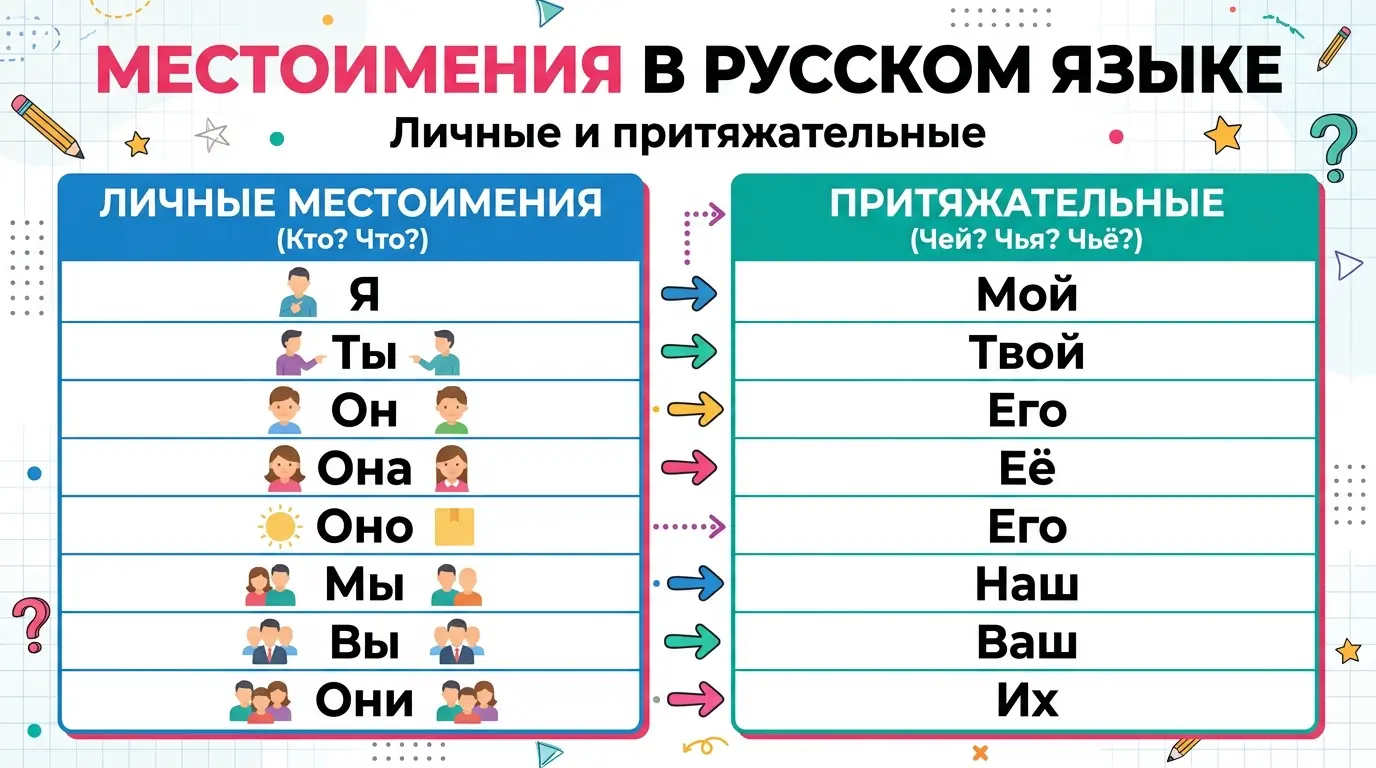
Russian personal pronouns identify a person or thing; possessive pronouns show whose something is. Compare Я читаю — “I am reading”, Она слушает меня — “She is listening to me”, and Это моя книга — “This is my book”. The form depends on the pronoun’s role: personal pronouns change by case, while most possessive forms agree with the noun they describe.
Personal pronouns as the subject
| Person | Singular | Plural |
|---|---|---|
| First: the speaker | я — I | мы — we |
| Second: the addressee | ты — you, informal | вы — you; also polite singular |
| Third: someone or something else | он — he; она — she; оно — it; also grammatical gender | они — they |
These are nominative forms, typically used for the subject: Мы работаем дома — “We work at home”. The verb agrees with the subject: я работаю, ты работаешь, они работают. Unlike English, Russian can omit a clear subject in context: Работаю дома is natural as an answer to a question about your work. Keep the pronoun when it clarifies who is involved or creates contrast: Я работаю, а он отдыхает.
Он, она and оно also refer to things according to the noun’s grammatical gender: Где паспорт? Он в сумке — “Where is the passport? It is in the bag”; Где письмо? Оно на столе — “Where is the letter? It is on the table”. Do not automatically use оно for every English “it”. In the plural, all genders use они.
Use ты with someone you address informally and вы with several people or one person politely. Polite вы still takes a plural verb: Вы живёте рядом? — “Do you live nearby?” Capitalized Вы is possible in respectful correspondence to one person; when addressing several people, write вы.
Personal pronouns in the six cases
English “me” does not correspond to just one Russian form: compare Она видит меня — “She sees me”, Она помогает мне — “She helps me”, and Она говорит со мной — “She is speaking with me”. The verb or preposition determines the case. Learn the construction together with the pronoun.
| Case | я | ты | мы | вы |
|---|---|---|---|---|
| Nominative | я | ты | мы | вы |
| Genitive | меня | тебя | нас | вас |
| Dative | мне | тебе | нам | вам |
| Accusative | меня | тебя | нас | вас |
| Instrumental | мной / мною | тобой / тобою | нами | вами |
| Prepositional | обо мне | о тебе | о нас | о вас |
| Case | он / оно | она | они |
|---|---|---|---|
| Nominative | он / оно | она | они |
| Genitive | его | её | их |
| Dative | ему | ей | им |
| Accusative | его | её | их |
| Instrumental | им | ей / ею | ими |
| Prepositional | о нём | о ней | о них |
Genitive and accusative forms coincide, but their functions differ: У меня есть билет uses genitive after у; Ты видишь меня? uses accusative. Forms can also coincide across different pronouns: Я пишу им means “I am writing to them”, while Я доволен им means “I am pleased with him”. Context and case identify the meaning. Мной and мною, тобой and тобою, ей and ею are valid instrumental variants.
After a preposition: у него, к ней, с ними
After common prepositions, third-person personal pronouns add initial н: его → у него; ему → к нему; её → без неё; ей → с ней; их → для них; ими → с ними. This also applies to things: письмо → в нём, “in it”. There are exceptions, including благодаря ему and вопреки ей; do not turn the pattern into “н after every preposition”.
Prepositions remain separate words. Learn the common combinations ко мне, со мной, обо мне. The prepositional forms in the tables are shown with о/обо because that case is never used without a preposition.
Possessive pronouns: whose is it?
Мой, твой, наш, ваш and свой agree with the thing possessed, not the owner’s gender. A man and a woman both say мой телефон but моя сумка. Choose the owner first, then the noun’s gender, number and case. The following table shows nominative forms.
| Owner | Masculine | Feminine | Neuter | Plural |
|---|---|---|---|---|
| я | мой | моя | моё | мои |
| ты | твой | твоя | твоё | твои |
| мы | наш | наша | наше | наши |
| вы | ваш | ваша | ваше | ваши |
| The subject’s own | свой | своя | своё | свои |
| он / оно | его | его | его | его |
| она | её | её | её | её |
| они | их | их | их | их |
The same forms work without a following noun: Это мой билет. Этот билет мой — “This is my ticket. This ticket is mine”. Russian does not have a separate pair like my/mine. In a short answer, preserve agreement: Чья это куртка? — Моя, “Whose jacket is this? — Mine”.
How мой changes by case
| Case | Masculine / neuter | Feminine | Plural |
|---|---|---|---|
| Nominative | мой / моё | моя | мои |
| Genitive | моего | моей | моих |
| Dative | моему | моей | моим |
| Accusative | мой / моего; моё | мою | мои / моих |
| Instrumental | моим | моей / моею | моими |
| Prepositional | о моём | о моей | о моих |
In masculine singular accusative, use мой with an inanimate noun and моего with an animate noun: он видит мой дом / моего брата. In plural accusative: он видит мои книги / моих друзей. Neuter singular stays моё. Compare case changes elsewhere: к моей сестре, “to my sister”; с моими друзьями, “with my friends”. Твой and свой follow the same pattern; наш and ваш have forms such as нашего, вашей, нашими.
Его, её and их do not change
Possessive его, её and их stay the same in every gender, number and case: её брат — её сестра — её письмо — её друзья — с её друзьями. They identify the owner, not the noun’s gender. Do not add н to these possessives after a preposition: у неё means “at her place / she has”, but у её сестры means “at her sister’s / her sister has”.
Свой or мой, его, её?
Свой normally refers back to the subject of the action in a simple clause. It can mean my, your, his, her, our or their own: Я беру свою сумку. Ты берёшь свою сумку. Мы берём свои сумки. The owner changes with the subject; the ending agrees with сумка or сумки. Свой is not restricted to third person.
| Sentence | Whose bag? |
|---|---|
| Олег взял свою сумку. | Oleg’s own bag. |
| Олег взял его сумку. | Another male person’s bag, identified in context. |
| Анна взяла свою сумку. | Anna’s own bag. |
| Анна взяла её сумку. | Another female person’s bag. |
With first and second person, мой/твой/наш/ваш can also be correct, especially for emphasis or contrast: Я беру мою сумку, а не твою — “I am taking my bag, not yours”. Do not replace every possessive with свой: Моя сестра работает здесь needs моя to identify whose sister is the subject. With several clauses or an infinitive, identify who performs each action; if ownership remains ambiguous, name the owner explicitly.
Useful constructions: names, possession and feelings
Some common Russian sentences use a case form where English uses a subject: Меня зовут Ирина — “My name is Irina”; Мне холодно — “I am cold”; Мне нравится этот город — “I like this city”. Do not put я into each sentence automatically. In the last example, город is the grammatical subject; мне identifies the person who likes it.
For possession, compare Это мой велосипед — “This is my bicycle” with У меня есть велосипед — “I have a bicycle”. The first identifies the owner; the second states possession or availability. The у construction uses a personal pronoun in genitive, not a possessive: у меня, у тебя, у нас, у вас, у него, у неё, у них.