


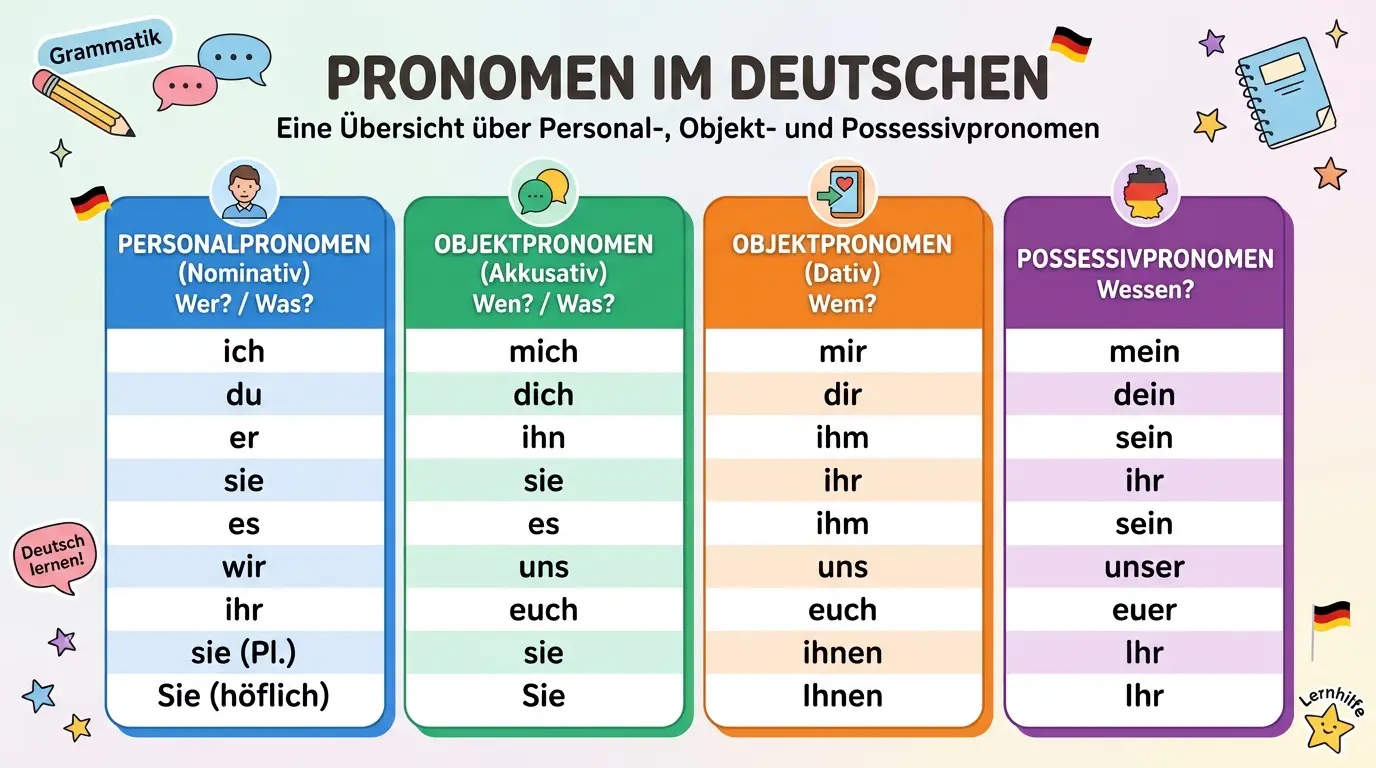
German pronouns change according to their role: ich means “I”, mich and mir are object forms, and mein expresses possession. Compare Ich sehe ihn. — “I see him” — with Er hilft mir. — “He helps me.” To choose the right form, identify the person, the grammatical role and, for possessives, the noun being referred to.
Subject and object pronouns: the main forms
Nominativ is the subject form. Akkusativ and Dativ are the two object cases you will use most often. English often uses one form where German distinguishes two: “me” can be mich or mir. The verb or preposition determines which case is needed.
| Person | Nominativ | Akkusativ | Dativ |
|---|---|---|---|
| I | ich | mich | mir |
| you: one person, informal | du | dich | dir |
| he | er | ihn | ihm |
| she | sie | sie | ihr |
| it | es | es | ihm |
| we | wir | uns | uns |
| you: several people, informal | ihr | euch | euch |
| they | sie | sie | ihnen |
| you: formal, singular or plural | Sie | Sie | Ihnen |
These are the everyday subject and object forms. Personal pronouns also have genitive forms, but those are uncommon in everyday speech and are not the same as possessive words such as mein or dein.
Subject pronouns: gender and verb agreement
The subject determines the verb form: ich komme, du kommst, er kommt, wir kommen, ihr kommt, sie kommen. German also uses er and sie for objects, according to the noun’s grammatical gender; English “it” does not always become es.
Der Schrank ist neu. Er steht im Flur.
The cupboard is new. It is in the hallway.
Die Uhr ist alt. Sie funktioniert noch.
The clock is old. It still works.
Das Fenster ist offen. Es ist sehr groß.
The window is open. It is very large.
Akkusativ or Dativ: follow the German verb
Many verbs take an accusative object, including sehen, kennen, besuchen and anrufen. Other verbs require dative, including helfen, danken, antworten and gefallen. Learn the case with the verb.
| Construction | Example | Translation |
|---|---|---|
| anrufen + Akkusativ | Ich rufe dich später an. | I will call you later. |
| helfen + Dativ | Kannst du mir helfen? | Can you help me? |
| für + Akkusativ | Das Geschenk ist für sie. | The present is for her / them. |
| mit + Dativ | Ich fahre mit ihm. | I am travelling with him. |
A preposition can determine the case too: für mich, ohne dich, mit uns, bei euch. In Das gefällt mir, das is the subject and mir is dative: “I like that.” The person experiencing something is not automatically the grammatical subject.
Sie, sie and ihr: look at the whole sentence
Sie with a capital letter is formal “you” and takes the same verb form as plural sie: Sie kommen. The forms Ihnen and possessive Ihr also retain the capital. Lowercase sie means “she” or “they”; the verb and context distinguish them. At the start of a sentence, capitalization alone cannot tell you which meaning is intended.
| Example | Meaning |
|---|---|
| Heute kommt sie. | She is coming today. |
| Heute kommen sie. | They are coming today. |
| Kommen Sie heute? | Are you coming today? Formal address. |
| Ihr habt Zeit. | You have time. Informal plural subject. |
| Ich helfe ihr. | I am helping her. Dative. |
| Das ist ihr Fahrrad. | That is her / their bicycle. Possessive. |
Possessive forms: first identify the owner
The basic possessive form tells you whose person or thing is meant. Its ending then depends on the gender, number and case of the noun that follows. These are two separate choices: owner → base; noun → ending.
| Owner | Base | Meaning |
|---|---|---|
| ich | mein- | my |
| du | dein- | your: informal singular |
| er / es | sein- | his / its |
| sie | ihr- | her |
| wir | unser- | our |
| ihr | euer- / eur- | your: informal plural |
| sie | ihr- | their |
| Sie | Ihr- | your: formal |
Jonas sucht seine Tasche. Lea sucht ihren Schlüssel.
Jonas is looking for his bag. Lea is looking for her key.
In seine Tasche, sein- refers to Jonas and -e matches feminine Tasche in the accusative. In ihren Schlüssel, ihr- refers to Lea and -en marks masculine accusative Schlüssel. The owner’s gender does not determine the ending.
Before a noun: the endings of mein, dein and other possessives
Before a noun, these words are called possessive determiners or Possessivartikel. They take the place of the article: mein Buch, not das mein Buch. Use the following pattern with the other possessive bases too.
| Case | Masculine | Feminine | Neuter | Plural |
|---|---|---|---|---|
| Nominativ | mein | meine | mein | meine |
| Akkusativ | meinen | meine | mein | meine |
| Dativ | meinem | meiner | meinem | meinen |
| Genitiv | meines | meiner | meines | meiner |
Mein Bruder kommt. — My brother is coming.
Ich besuche meinen Bruder. — I am visiting my brother.
Ich fahre mit meiner Schwester. — I am travelling with my sister.
Das ist das Fahrrad meines Bruders. — That is my brother’s bicycle.
With an ending, euer normally becomes eur-: euer Hund, eure Katze, euren Hund, mit eurem Hund. Noun endings still matter too: mit meinen Freunden has dative plural -n; meines Bruders has genitive -s.
Without a noun: meiner, meine, meins
A possessive pronoun can replace a noun that is already clear from context. Compare Das ist mein Stift. — “That is my pen” — with Der Stift ist meiner. — “The pen is mine.” Without the noun, masculine nominative and neuter nominative/accusative need endings that the determiner does not have.
| Case | Masculine | Feminine | Neuter | Plural |
|---|---|---|---|---|
| Nominativ | meiner | meine | meins / meines | meine |
| Akkusativ | meinen | meine | meins / meines | meine |
| Dativ | meinem | meiner | meinem | meinen |
The case follows the pronoun’s role in its own sentence: Du hast deinen Stift. Ich nehme meinen. — “You have your pen. I will take mine.” Here meinen is accusative after nehmen. For a neuter noun: Ist das dein Handy? Nein, meins liegt zu Hause. — “Is that your phone? No, mine is at home.”
Where do object pronouns go?
Unstressed object pronouns usually occur early in the middle of the sentence. If both objects are personal pronouns, the neutral order is accusative before dative. If only one object is a pronoun, it normally precedes the noun object. With two full noun objects, dative commonly comes before accusative.
| Pattern | Example |
|---|---|
| Two noun objects | Ich zeige meinem Bruder das Foto. |
| Dative pronoun + noun | Ich zeige ihm das Foto. |
| Accusative pronoun + noun | Ich zeige es meinem Bruder. |
| Two pronouns | Ich zeige es ihm. |
The first sentence means “I am showing my brother the photo”; the last means “I am showing it to him”. These are neutral patterns, not a ban on other orders under contrastive stress. In a question, keep the subject and objects distinct: Kannst du es mir zeigen? — “Can you show it to me?”
Quick check: common mistakes
| Incorrect | Correct | Reason |
|---|---|---|
| Er hilft mich. | Er hilft mir. | Helfen requires dative. |
| Ich rufe dir an. | Ich rufe dich an. | Anrufen requires accusative. |
| Das ist mein Tasche. | Das ist meine Tasche. | Tasche is feminine. |
| Der Stift ist mein. | Der Stift ist meiner. | Use the standalone form in ordinary modern usage. |
| Ich fahre mit Sie. | Ich fahre mit Ihnen. | Formal you after mit is dative Ihnen. |