




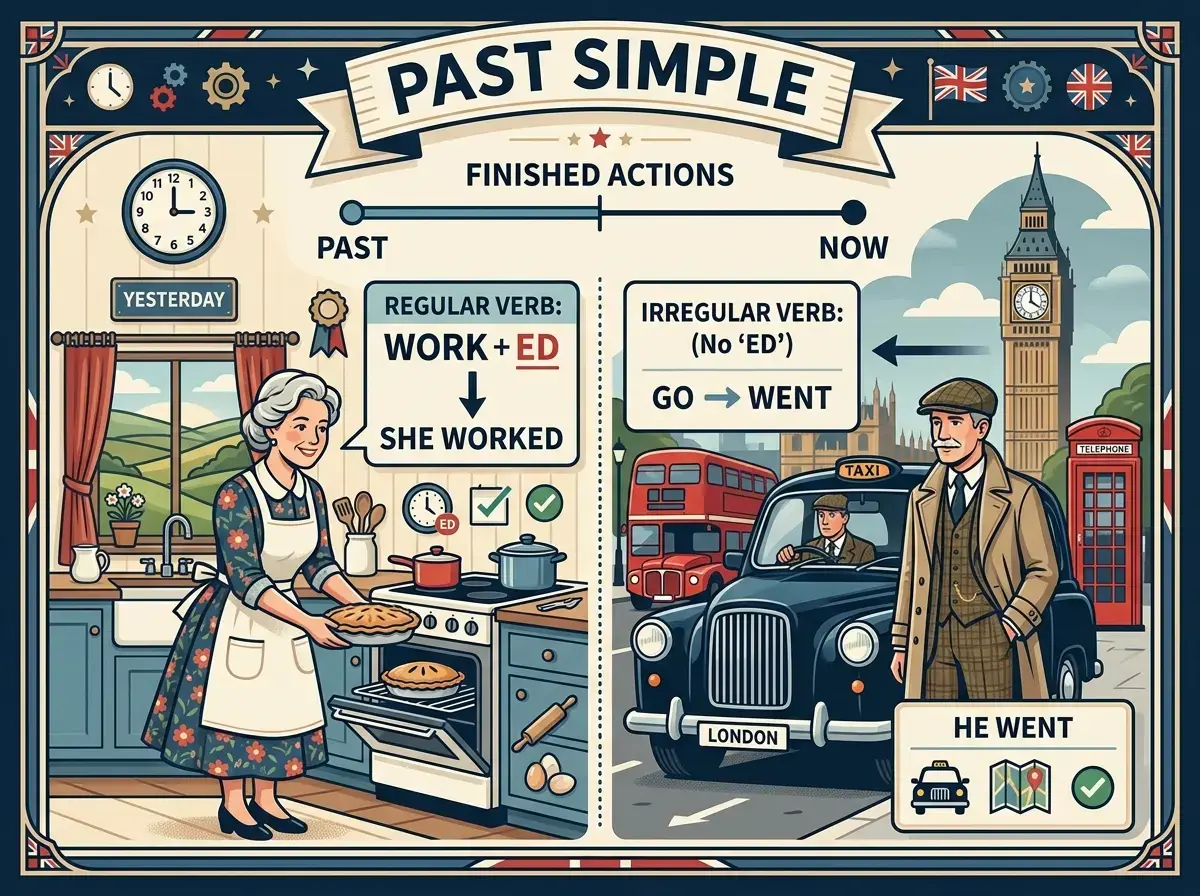
The Past Simple describes events, states and habits within a finished past time frame. It can refer to yesterday, many years ago or a time already clear from the conversation. Use a past form in affirmative sentences: I worked, She went. Questions and negatives usually use did + base form. The verb be has its own forms: was and were.
When do you use the Past Simple?
Use the Past Simple for a completed event, a sequence of events, a past state or a repeated past action. It does not mean that every action was quick, happened only once or has no consequences now. They lived there for twenty years describes a long period; I broke my glasses yesterday can still explain why you cannot read today.
| Use | Example | Meaning |
|---|---|---|
| Completed event | We booked a room last night. | A booking made at a finished past time. |
| Sequence | She opened the email, read it and replied. | Events presented in order. |
| Past state | The office was empty. | A description of a past situation. |
| Past habit | At university, I cycled to class every day. | A repeated action in a past period. |
A past time does not need to be repeated in every sentence: How was the interview? — It went well. They asked about my experience. The interview supplies the past context. Past habits can also be described with used to, but the Past Simple alone does not always explicitly say that the habit has stopped.
Affirmative sentences: one past form for every person
For ordinary verbs, use subject + past form. Regular verbs take -ed; irregular verbs have a special form. Unlike the Present Simple, there is no extra -s with he, she or it: I worked, she worked, they worked; I went, he went, we went. Do not add was or were before this past form.
Regular verbs: spelling and pronunciation of -ed
| Rule | Examples |
|---|---|
| Usually add -ed | work → worked; clean → cleaned |
| Final -e: add -d | live → lived; agree → agreed |
| Consonant + y: change y to -ied | study → studied; carry → carried |
| Vowel + y: keep y | play → played; enjoy → enjoyed |
| Short consonant–vowel–consonant verb: double the final consonant | stop → stopped; plan → planned |
| In longer verbs, check final-syllable stress | prefer → preferred; visit → visited |
Do not double final w, x or y: snowed, fixed, played. British and American spelling can differ: travelled is usual in British English, traveled in American English. Use one spelling variety consistently.
The ending -ed has three usual pronunciations. After /t/ or /d/, it adds a syllable, /ɪd/: wanted, needed. After another voiceless sound, it is /t/: worked, watched. After a vowel or another voiced sound, it is /d/: played, cleaned. Choose by the final sound of the base verb, not just its last letter.
Common irregular past forms
Use the past form, often called V2, in affirmative Past Simple sentences. Do not replace it with the past participle used after have: I saw her, not “I seen her”; He wrote to me, not “He written to me”.
| Base form | Past Simple | Example |
|---|---|---|
| go | went | We went home. |
| come | came | She came early. |
| see | saw | I saw the message. |
| take | took | He took a taxi. |
| write | wrote | They wrote a report. |
| buy | bought | We bought new chairs. |
| have | had | I had a meeting. |
| do | did | She did the shopping. |
| make | made | He made dinner. |
| read /riːd/ | read /red/ | I read the instructions. |
Negatives: didn’t + base form
Use subject + did not + base form. Did not contracts to didn’t and works with every subject. The main verb returns to its base form because did already marks the past: She didn’t call, We didn’t go, He didn’t have time.
The same rule applies when do is the main verb: I didn’t do the exercise. The first did is the auxiliary; do describes the action. Do not keep the past form after didn’t: “didn’t went” and “didn’t bought” are incorrect in standard English.
Questions and short answers
For a yes/no question, use Did + subject + base form? Put a question word before this pattern when needed: Where did you stay?, Why did she leave? In a short answer, repeat did or didn’t rather than the main verb.
| Question | Yes | No |
|---|---|---|
| Did you enjoy the concert? | Yes, I did. | No, I didn’t. |
| Did Ella send the file? | Yes, she did. | No, she didn’t. |
| Did the guests arrive on time? | Yes, they did. | No, they didn’t. |
A neutral question about the subject does not need did: Who called you? Compare Who did you call?: here you is the subject and who is the object. A negative subject question does use did: Who didn’t receive the email?
Be in the past: was and were
For ordinary past statements, use was with I/he/she/it and were with you/we/they. Add not directly for a negative: wasn’t, weren’t. For a question, move was or were before the subject. Do not add did to these be constructions.
| Affirmative | Negative | Question and answer |
|---|---|---|
| She was tired. | She wasn’t tired. | Was she tired? — Yes, she was. |
| They were at home. | They weren’t at home. | Were they at home? — No, they weren’t. |
Be can describe identity, a condition or location: I was a student, The weather was cold, We were in Berlin. With an -ing verb, was/were forms the Past Continuous instead: We were waiting. Do not confuse the two patterns.
Time expressions: yesterday, last and ago
Common expressions are yesterday, last week, in 2021, on Monday and three days ago. Ago comes after the amount of time. Do not add a preposition before yesterday or last week: I called yesterday, not “on yesterday”. Time expressions often come at the end or beginning: Last week we moved house. The subject still comes before the verb.
Past Simple or Present Perfect?
The Past Simple places an event in a finished past time frame: I sent the application yesterday. The Present Perfect connects it to now without that finished-time setting: I have sent the application. A current consequence does not override an explicit past time: I lost my keys yesterday, so I can’t open the door is correct.
Ask about experience up to now with Have you ever visited Edinburgh? Then use the Past Simple for the details: When did you go? The distinction is not “recent versus long ago”: I called five minutes ago is Past Simple despite being recent.
Past Simple or Past Continuous?
The Past Simple presents an event as a whole. The Past Continuous presents an activity as in progress at a past moment. Compare I cooked dinner with I was cooking dinner when you called. In the second sentence, cooking is the background activity and the call happens during it. A long action can still take the Past Simple: I worked all day.
Common Past Simple mistakes
| Incorrect | Correct | Reason |
|---|---|---|
| I didn’t went. | I didn’t go. | Base form after did. |
| Did she bought it? | Did she buy it? | Did already marks the past. |
| He goed home. | He went home. | Irregular past form. |
| Did you were tired? | Were you tired? | Question with be, not did. |
| They was late. | They were late. | Were with they. |
| She was arrived yesterday. | She arrived yesterday. | No extra be before the active past form. |