

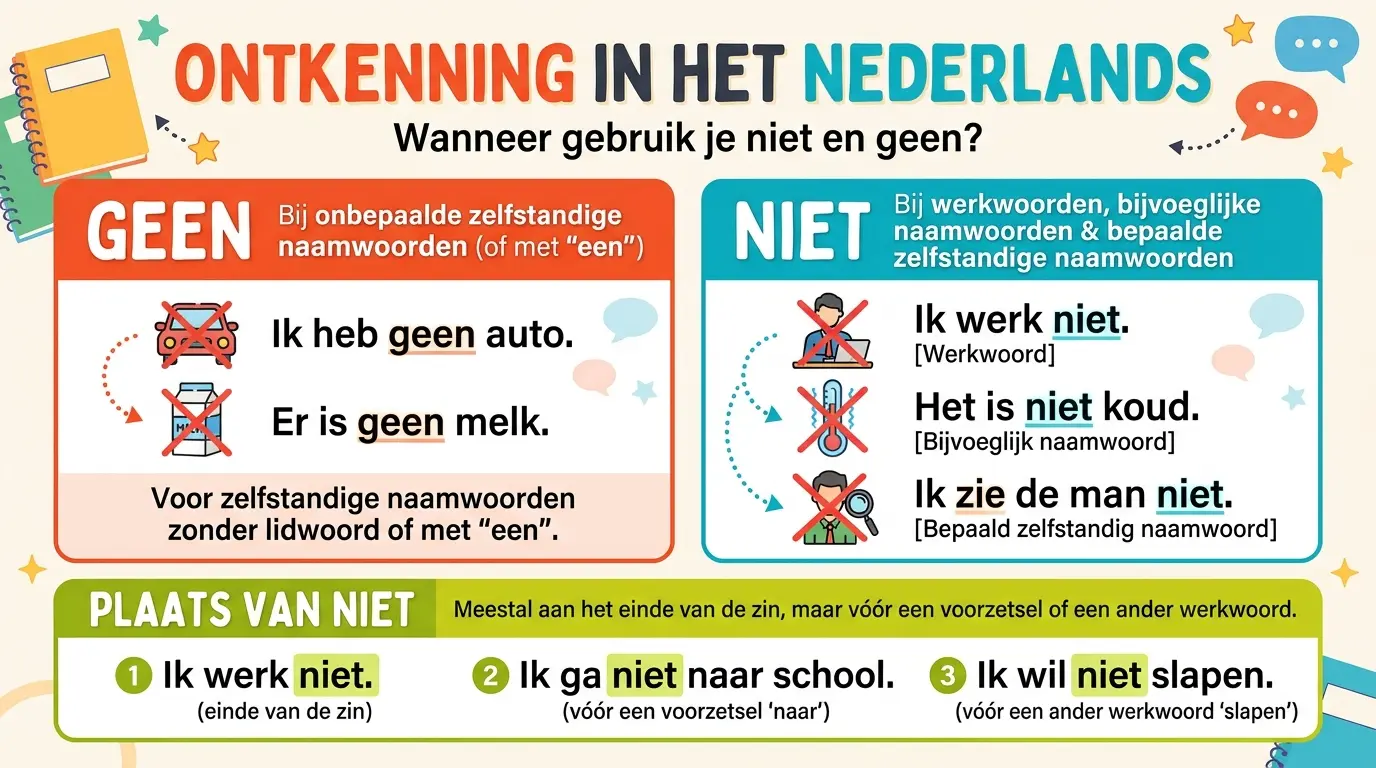
Dutch normally expresses negation with niet and geen. Both can translate as “not”, but they do different jobs:
Ik heb geen rijbewijs. Ik rijd niet.
I do not have a driving licence. I do not drive.
In the first sentence, geen expresses complete absence: the speaker has no driving licence. In the second, niet negates the action. Geen also rejects membership of a category: Zij is geen journalist — She is not a journalist. To deny a quality, use niet: Dit artikel is niet interessant — This article is not interesting.
When to use geen
Use geen when the positive sentence contains een or an indefinite noun without an article. Geen replaces een, or stands before the noun that previously had no article:
| Positive | Negative |
|---|---|
| Ik heb een rijbewijs. | Ik heb geen rijbewijs. |
| We ontvangen bezoekers. | We ontvangen geen bezoekers. |
| Er zit suiker in deze saus. | Er zit geen suiker in deze saus. |
Geen bezoekers means not a single visitor; geen suiker means no sugar at all in the sauce. The absence is complete within the situation you describe. Compare Er zit niet veel suiker in deze saus: the amount is small, without claiming that it is zero. With bijna geen suiker, bijna changes the meaning to almost no sugar.
An adjective inside the noun phrase does not change this choice: geen nieuwe berichten means no new messages; it says nothing about older messages. Compare We hebben geen beschikbaar appartement — We have no apartment available — with Het appartement is niet beschikbaar — The apartment is not available. In the second sentence, niet negates the property beschikbaar.
Geen also appears with professions and languages that have no article: Mijn partner is geen architect — My partner is not an architect; Onze gids spreekt geen Japans — Our guide does not speak Japanese. These are reasons not to choose the Dutch negative simply by translating English not.
When to choose niet instead
If a noun already has de, het, mijn, deze or another word identifying it, keep that phrase and use niet. Compare Ik heb geen tickets ontvangen — I have received no tickets — with Ik heb de tickets niet ontvangen — I have not received the tickets. The second sentence denies receiving specific tickets; it does not say that you possess no tickets of any kind.
Use niet for actions and properties too: De scanner reageert niet — The scanner does not respond; De uitleg is niet duidelijk — The explanation is not clear. Where niet stands depends on the construction. Here are the rules.
Where does niet go?
1. One verb: at the end when you negate the action
In a main clause with one verb, niet goes at the end when you negate the action as a whole. A definite object or object pronoun comes before niet. This pattern also works with a time expression: We gebruiken de scanner vandaag niet — We are not using the scanner today.
Ik gebruik deze oplader niet. Ik gebruik hem niet.
I do not use this charger. I do not use it.
Do not apply this rule to every sentence with one conjugated verb: an adjective, prepositional phrase or separated verb part follows its own placement rule below.
2. Two or more verbs: before the final verb group
In the Perfectum, niet precedes the participle. With a modal verb, it precedes the final infinitive. If several verbs stand together at the end, put niet before that group: De monteur zal het onderdeel niet kunnen vervangen — The technician will not be able to replace the part.
We hebben de bijlage niet geopend. We kunnen de bijlage niet openen.
We did not open the attachment. We cannot open the attachment.
3. Separable verbs: before the detached part
In a main clause, aanzetten splits into zet … aan. To negate the action, put niet before aan. In the Perfectum, aangezet is one word, and niet precedes the whole participle.
Ik zet de ventilator niet aan. Ik heb de ventilator niet aangezet.
I am not switching on the fan. I did not switch on the fan.
4. Adjectives and adverbs: before the property or manner
Niet precedes the adjective or adverb you negate. With an expanded phrase, it comes before that phrase: niet erg duidelijk — not very clear; niet helemaal droog — not completely dry. These differ in meaning from a simple niet duidelijk or niet droog.
Het tapijt is niet droog. De lift beweegt niet soepel.
The carpet is not dry. The lift does not move smoothly.
5. Prepositional phrases: before the whole phrase
When you negate a location, direction or other prepositional phrase, niet comes before the preposition: niet in de kelder, niet met de verhuurder. Keep the phrase together; niet does not go between the preposition and the noun.
De voorraad staat niet in de kelder. Ik overleg niet met de verhuurder.
The stock is not in the cellar. I am not consulting the landlord.
A time phrase can instead set the scene for the whole sentence: Na de pauze vergaderen we niet — We are not meeting after the break. Here you negate the meeting, not the time phrase itself. To correct the time, say We vergaderen niet na de pauze, maar ervoor.
6. Subordinate clauses: before the final verb group
After omdat, dat or als, the verb or verb group goes to the end of the subordinate clause. For action negation, niet precedes that group.
Ik bel de klantenservice omdat de code niet werkt.
I am calling customer service because the code does not work.
Zij zegt dat ze het bestand niet heeft opgeslagen.
She says that she did not save the file.
In this Perfectum example, niet heeft opgeslagen and niet opgeslagen heeft are both possible: niet stays before the complete group. With an adjective, its rule remains intact: omdat het tapijt niet droog is — because the carpet is not dry. Geen also stays with its noun: omdat we geen toegang hebben — because we have no access.
Questions and inversion
A question or a time expression at the beginning changes the position of the conjugated verb, not the rule for niet: Gebruiken jullie de scanner niet? — Are you not using the scanner? Vandaag hebben we de scanner niet gebruikt. — We did not use the scanner today. Niet still precedes the final participle in the second sentence.
Contrast: what exactly are you denying?
To correct one part of a statement, put niet immediately before that part. Maar often introduces the alternative. Moving niet then changes what you are saying:
We vergaderen dinsdag niet. We vergaderen niet dinsdag, maar donderdag.
We are not meeting on Tuesday. We are meeting on Thursday, not Tuesday.
Explicit contrast also allows Ik zoek niet een kleine opslagruimte, maar een grote — I am looking for a large storage space, not a small one. This contrasts sizes; it does not mean that no storage space is wanted. For ordinary indefinite negation without that contrast, use geen.
Keep niet alle and geen enkele apart: Niet alle liften werken means not all lifts work; Geen enkele lift werkt means not a single lift works. Likewise, niet altijd means not always, while nooit means never.
Not yet and no longer: nog niet and niet meer
Nog niet says that something has not happened up to now. Niet meer says that a previous situation has ended. With an indefinite noun, use nog geen or geen … meer:
| Expression | Dutch example | Meaning |
|---|---|---|
| nog niet | De bestelling is nog niet aangekomen. | The order has not arrived yet. |
| nog geen | We hebben nog geen bevestiging ontvangen. | We have not received a confirmation yet. |
| niet meer | Deze toegangscode werkt niet meer. | This access code no longer works. |
| geen … meer | We hebben geen reserveonderdelen meer. | We have no spare parts left. |
Other negative words: niets, niemand, nergens, nooit
These words already express negation. Do not add niet for the same negative meaning. Their position depends on their function: niemand can be a subject, niets an object, and nooit an expression of frequency.
| Word | Dutch example | Meaning |
|---|---|---|
| niets | De update heeft niets veranderd. | The update has changed nothing. |
| niemand | Niemand heeft op de uitnodiging gereageerd. | Nobody has responded to the invitation. |
| nergens | Ik kan deze batterij nergens bestellen. | I cannot order this battery anywhere. |
| nooit | Deze winkel is op maandag nooit open. | This shop is never open on Mondays. |
Useful combinations are nog niemand — nobody yet; niets meer — nothing more; and nog nooit — never before. Nauwelijks means hardly: De microfoon registreert nauwelijks geluid is close in meaning to bijna geen geluid, not to no sound whatsoever.
Replying with wel
To contradict a negative assumption, use jawel or a full answer with wel. If the negative assumption is correct, use Nee, ik heb hem niet ontvangen in the example below. A complete sentence avoids uncertainty about what yes or no refers to.
Heb je de factuur niet ontvangen? — Jawel, ik heb hem wel ontvangen.
Did you not receive the invoice? — Yes, I did receive it.
Common mistakes: a quick reference
| Avoid | Use | Why? |
|---|---|---|
| We hebben geen een abonnement. | We hebben geen abonnement. | Geen replaces een. |
| Ik gebruik geen deze oplader. | Ik gebruik deze oplader niet. | Deze oplader is definite; negate the action with niet. |
| We hebben de bijlage geopend niet. | We hebben de bijlage niet geopend. | Niet precedes the final participle. |
| Het tapijt is geen droog. | Het tapijt is niet droog. | Droog describes a property; it is not a noun. |
| Ik zet de ventilator aan niet. | Ik zet de ventilator niet aan. | Niet precedes the separated verb part. |
| … omdat de code werkt niet. | … omdat de code niet werkt. | In a subordinate clause, niet precedes the final verb. |
| Niemand heeft niet gereageerd. | Niemand heeft gereageerd. | For the intended meaning nobody responded, niemand already supplies the negation. |
| Je hoeft de deur niet sluiten. | Je hoeft de deur niet te sluiten. | Hoeven takes te with the infinitive in this construction. |
Start with the choice between niet and geen, then check the construction. Geen belongs with an indefinite noun phrase; niet follows the placement rule for the action or the particular element you negate.